Left atrial strain predicts heart failure in the general population
European Heart Journal


Abstract
Left atrial (LA) function has shown to be a significant predictor of cardiovascular outcomes. We sought to determine the prognostic value of LA strain in relation to incident heart failure (HF) in the general population.
The present study includes 3,540 participants from the general population without prevalent atrial fibrillation or HF. All participants underwent health examinations and echocardiography including measures of LA function by means of peak atrial longitudinal strain (PALS), peak atrial contraction strain (PACS), and LA strain during the conduit phase (LACS). Cox proportional hazards regressions were utilised to access the association between incident HF and LA strain parameters.
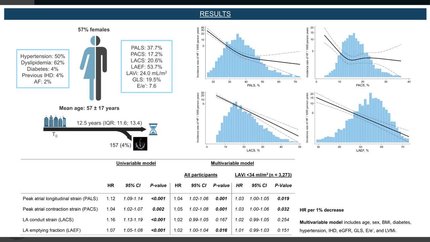
Median age of the study population was 57 years (interquartile range: 40, 69) and 2,015 (57%) were female. During follow-up (median 5.4 years), 66 (2%) participants were diagnosed with HF. Participants who developed HF had lower PALS (26.4% vs. 36.6%, p<0.001), PACS (15.6% vs. 16.5%, p=0.016), and LACS (11.4% vs. 19.3%, p<0.001) at baseline. Lower values of all three LA strain parameters were associated with a higher risk of developing HF in univariable analysis (Figure 1 & 2). After multivariable adjustments for Framingham Risk Score and global longitudinal strain, PALS (HR=1.06, 95% CI [1.03; 1.09], p<0.001, per 1% decrease), PACS (HR=1.07, 95% CI [1.02; 1.12], p=0.003, per 1% decrease), and LACS (HR=1.05, 95% CI [1.01; 1.10], p=0.016, per 1% decrease) remained significantly associated with incident HF. However, in participants with normal-sized LA (LA volume index <34 ml/m2) and no ischemic heart disease (n=3,046), only PALS and PACS remained independent predictors of HF (Figure 2).
LA strain provides independent prognostic value regarding the risk of incident HF in the general population.
Type of funding sources: Other. Main funding source(s): The Danish Heart Foundation and The Metropolitan Region of Denmark
Figure 1
Figure 2
Contributors

A Nielsen
Author
K Skaarup
Author
R Hauser
Author
N Johansen
Author
M Lassen
Author
R Inciardi
Author
G Jensen
Author
P Schnohr
Author
R Moegelvang
Author
T Biering-Soerensen
Author
You may be interested in