Subclinical myocardial dysfunction in patients with persistent dyspnea one year after COVID-19
European Heart Journal


Abstract
Coronavirus disease 2019 (COVID-19) rapidly spread across the globe,evolving into a global pandemic,with a crucial impact on healthcare systems. Several short-term follow-up studies emphasized the persistence of symptoms, referred as long COVID, in a significant number of discharged patients even without history of cardiopulmonary diseases, with dyspnea being one of the most frequent complaint [1–3]. Even though those reports on recovered COVID-19 patients did not describe major left ventricle (LV) function abnormalities, subtle cardiac changes may be present.
We aimed to investigate the presence of subclinical cardiac dysfunction, assessed by transthoracic echocardiography (TTE) in recovered COVID-19 patients, without previous cardiopulmonary disease at 1 year follow-up.
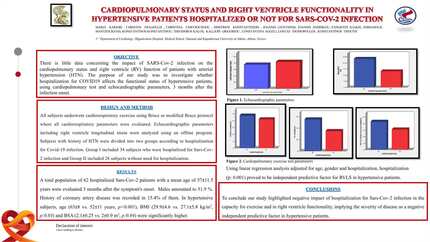
310 COVID-19 consecutive hospitalized patients were prospectively included between March and April 2020. 66 patients out of 251 recovered patients had no previous history of coronary artery disease, arrhythmia, arterial hypertension, valvular heart disease, asthma, chronic obstructive pulmonary disease and obstructive sleep apnea, respectively and were included in the final analysis (Figure 1). The follow-up consisted in 2 parts, a 6-months visit including clinical and physical examination, chest computed tomography and spirometry and a 12-months visit including clinical and physical examination, spirometry and TTE.
66 patients (mean age 51.39±11.15 years, 45 (68.2%) males) were included in the final analysis. 23 (34.8%) patients reported dyspnea at 1 year. TTE parameters were in the normal range, with a mean LV ejection fraction of 56.9±4.6%, mean global longitudinal strain (GLS) of −20.9±2.3%, global constructive work (GCW) of 2381.4±463.6 mmHg% and global work index (GWI) of 2132.5±419.2 mmHg%. Type 1 diastolic dysfunction was observed in 11 (16.7%) patients. One (1.5%) patient had type 2 diastolic dysfunction. A normal respiratory pattern was reported in 31 (47%) patients at 6 months spirometry, while 19 (28.8%) patients had a restriction pattern. No significant differences regarding clinical, laboratory or imaging findings at baseline were found between groups.
The following TTE parameters were significantly different in patients with and without dyspnea at 1 year: GLS (−19.97±2.14 vs. −21.38±2.37, p=0.039), GCW (2183.72±487.93 vs. 2483.14±422.42, p=0.024) and GWI (1960.06±396.21 vs. 2221.17±407.99, p=0.030). Multivariable logistic regression showed that GCW and GWI were inversely and independently associated with persistent dyspnea, one year after COVID-19 (p=0.035, OR 0.998, 95% CI 0.997–1.000; p=0.040, OR 0.998, 95% CI 0.997–1.000) (Table 1).
Persistent dyspnea one year after COVID-19 was present in more than a third of patients without known cardiovascular or pulmonary diseases. GCW and GWI were the only echocardiographic parameters independently associated with symptoms, suggesting a decrease in myocardial performance in this population and subclinical cardiac dysfunction.
Type of funding sources: None.
Figure 1. Study design
Table 1
Contributors

M L Luchian
Author
A Motoc
Author
B Roosens
Author
J Magne
Author
H Chameleva
Author
J Geers
Author
B Von Kemp
Author
L Houard
Author
K Van Den Bussche
Author
S Boeckstaens
Author
T De Potter
Author
S Lochy
Author
C Weytjens
Author
S Droogmans
Author
B Cosyns
Author
You may be interested in