Abstract
Whilst the risk factors for type 1 myocardial infarction due to atherosclerotic plaque rupture and thrombosis are established, our understanding of the factors that predispose to type 2 myocardial infarction during acute illness is still emerging. Our aim was to evaluate and compare the risk factors for type 1 and type 2 myocardial infarction.
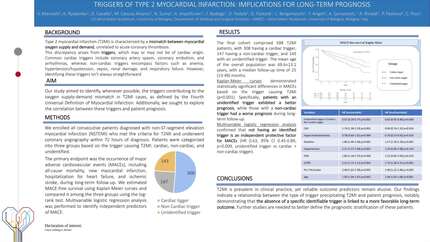
We conducted a secondary analysis of a multi-centre randomized trial population of 48 282 consecutive patients attending hospital with suspected acute coronary syndrome. The diagnosis of myocardial infarction during the index presentation and all subsequent reattendances was adjudicated according to the Universal Definition of Myocardial Infarction. Cox regression was used to identify predictors of future type 1 and type 2 myocardial infarction during a 1-year follow-up period. Within 1 year, 1331 patients had a subsequent myocardial infarction, with 924 and 407 adjudicated as type 1 and type 2 myocardial infarction, respectively. Risk factors for type 1 and type 2 myocardial infarction were similar, with age, hyperlipidaemia, diabetes, abnormal renal function, and known coronary disease predictors for both (
Risk factors for coronary disease that are associated with type 1 myocardial infarction are also important predictors of type 2 events during acute illness. Treatment of these risk factors may reduce future risk of both type 1 and type 2 myocardial infarction.
Contributors

Ryan Wereski
Author
Dorien M Kimenai
Author
Anda Bularga
Author
Caelan Taggart
Author
David J Lowe
Author

Nicholas L Mills
Author
University of Edinburgh Edinburgh , United Kingdom of Great Britain & Northern Ireland

Andrew R Chapman
Author
Royal Infirmary of Edinburgh Edinburgh , United Kingdom of Great Britain & Northern Ireland
You may be interested in