Increased BACE1-AS long noncoding RNA and β-amyloid levels in heart failure
Cardiovascular Research


Abstract
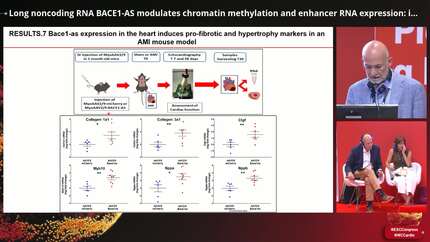
Antisense long noncoding RNAs (ncRNAs) are transcripts emerging from the opposite strand of a coding-RNA region and their role in heart failure (HF) is largely unknown. Additionally, HF and Alzheimer’s disease (AD) share several non-genetic effectors and risk factors. We investigated the regulation of the β-secretase-1 (BACE1) gene and of its antisense transcript BACE1-AS in ischaemic HF.
BACE1 and BACE1-AS expression was measured in left ventricle biopsies from 18 patients affected by non-end stage ischaemic HF and 17 matched controls. The levels of both transcripts were increased in HF patients. Likewise, both transcripts increased also in a mouse model of ischaemic HF, and their expression was directly correlated. BACE1-AS was expressed by all cardiac cell types and BACE1-AS up- or down-modulation in cultured cardiomyocytes and endothelial cells induced a concordant regulation of the cognate BACE1 transcript. Interestingly, BACE1 increase also induced the intracellular accumulation of its product β-amyloid. In keeping with these findings, higher BACE1 protein and β-amyloid peptide levels were also observed in HF. Moreover, increased β-amyloid 1-40 was also found in the plasma of HF patients. Transcriptomic changes of BACE1-AS overexpressing and β-amyloid 1-40 treated cells were largely overlapping and indicated changes of relevant biological process such as ‘cell cycle and proliferation’, ‘apoptosis’, and ‘DNA repair’ as well as ‘TGFβ-, TNFα-, p38-, EGFR-signalling’, suggesting a potential maladaptive role of the BACE1-AS/BACE1/β-amyloid axis. Accordingly, the administration of β-amyloid peptides decreased the cell viability in endothelial cells and in both human IPS-derived and mouse cardiomyocytes. Moreover, both β-amyloid treatment and BACE1-AS overexpression increased endothelial cell apoptosis, and this effect was prevented by BACE1 silencing.
Given the neurotoxic role of β-amyloid in AD, dysregulation of the BACE1/BACE1-AS/β-amyloid axis might be relevant in HF pathogenesis, further implicating ncRNAs in the complex scenario of proteotoxicity in cardiac dysfunction.
Contributors

Simona Greco
Author
Germana Zaccagnini
Author
Paola Fuschi
Author
Christine Voellenkle
Author
Matteo Carrara
Author
Iman Sadeghi
Author
Claudia Bearzi
Author
Biagina Maimone
Author
Serenella Castelvecchio
Author
Konstantinos Stellos
Author
Carlo Gaetano
Author
Lorenzo Menicanti
Author

You may be interested in