Vitamin D receptor restricts T helper 2-biased inflammation in the heart
Cardiovascular Research


Abstract
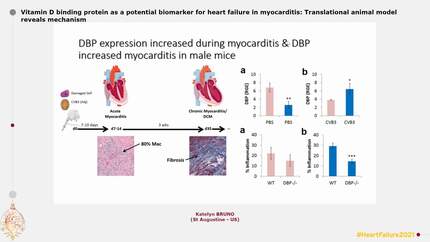
The aberrant immune responses play a critical role in the pathogenesis of myocarditis. Vitamin D receptor (VDR) has immune regulatory functions. This study aims to investigate the role of VDR in restricting the immune inflammation in the heart.
The human heart samples were obtained from the heart transplantation. T helper (Th)2 and Th1 responses in the heart tissue were characterized by histology and immune assay. VDR−/− mice and recombination activating gene 2−/− mice were used in the experiments to test the role of VDR in maintaining the homeostasis in the heart. The results showed that, besides tissue damage, lower expression of VDR, high frequency of Th2 cells and increase in Th2 cytokines in the hearts of patients with myocarditis at the end stage of heart failure. The spontaneous Th2-biased inflammation was observed in the hearts of VDR−/− mice. CD4+ T cells from the VDR−/− mouse hearts were at highly activating status. The naïve VDR−/− CD4+ T cells and naïve CD4+ T cells from human hearts with myocarditis were prone to differentiate into Th2 cells. VDR formed complexes with GATA3, the interleukin (IL)-4 transcription factor, to prevent the
VDR-deficiency contributes to the pathogenesis of myocarditis. To enhance the VDR expression in CD4+, T cells haves the therapeutic potential for the treatment of myocarditis.
Contributors

Jiangping Song
Author
Xiao Chen
Author
Liang Cheng
Author
Man Rao
Author
Kai Chen
Author
Ningning Zhang
Author
Jian Meng
Author
Mengmeng Li
Author
Zhi-Qiang Liu
Author
Ping-Chang Yang
Author
You may be interested in