Interleukin 6 trans-signalling and risk of future cardiovascular events
Cardiovascular Research


Abstract
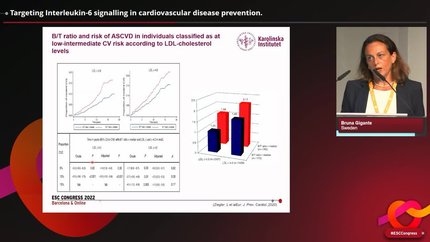
The pro-inflammatory response to interleukin 6 (IL6) trans-signalling in atherosclerosis is driven by the IL6 and soluble IL6 receptor (sIL6R) binary complex. The binary IL6:sIL6R complex is inactivated by sgp130 through the formation of the ternary IL6:sIL6R:sgp130 complex. The aim of this study was to investigate if IL6 trans-signalling, estimated by a ratio between the binary and ternary complexes, associates with the risk of future cardiovascular events (CVE) in a Swedish cohort of 60-year-old men and women (
Binary and ternary complex levels expressed in nanomol/Litre were derived from serum concentrations of IL6, sIL6R, and sgp130. Cox regression models were used to assess the risk of CVE (myocardial infarction, angina pectoris, and ischaemic stroke,
The ratio between the functional moieties of IL6 trans-signalling, IL6:sIL6R, and IL6:sIL6R:sgp130, was associated with CVE risk indicating that it could be a promising marker of CV risk and possibly be used in selecting patients for anti-inflammatory therapy.
Contributors


Ashwini Gajulapuri
Author
Paolo Frumento
Author
Alice Bonomi
Author
Håkan Wallén
Author
Ulf de Faire
Author
Stefan Rose-John
Author
Bruna Gigante
Author
You may be interested in