Abstract
Type of funding sources: Public grant(s) – National budget only. Main funding source(s): The National Medical Research Council (NMRC)
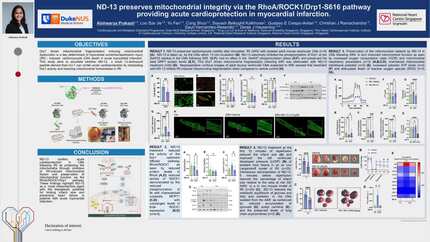
Additional protection beyond timely reperfusion is still needed as more patients who have survived an acute myocardial infarction (AMI) developed heart failure (HF)1. DJ-1 was recently reported as a cytoprotective protein that preserves mitochondrial complex I activity and subsequently inhibits mitochondrial reactive species (ROS) production2. DJ-1 downregulation dramatically increases the susceptibility to cell death after myocardial infarction in mice. A substantial reduction in total DJ-1 protein levels in left ventricular tissue has been identified in patients at the end-stage of human HF3, suggesting that DJ-1 protects the myocardium against AMI cell death and is essential in the remodelling process post-infarct. Purpose: The translation of cardioprotection to clinical practice has been difficult, and it remains a challenge between the bench and the bedside. Nanotechnology has shown significant improvements in the settings of AMI. Given the protective effect observed with DJ-1, we designed ND-13, a new cell-permeable 13- fragment of the DJ-1 amino acid sequence. Then, we loaded it into nanoparticles (ND-13NPs) to achieve cardioprotective outcomes against IRI. Methods: We tested the efficacy and efficiency of our new ND-13NPs to reduce infarct size in the ex vivo heart perfused IRI model and the in vivo AMI-murine model. Results: Naked ND-13 (20µM) continuously perfused for the first 15 minutes of reperfusion significantly improved LV pressure and systolic function. Afterwards, we tested 60 mg/Kg of the naked peptide injected 5 minutes before reperfusion in the in vivo model. ND-13 reduced 35% of the infarct size (non-treated, 49 ± 6.4% vs. treated, 32 ± 5 %). Fluorescently loaded ND-13NPs were intravenously injected into infarcted mice to assess their distribution in cardiac tissue. The ND-13NPs were abundantly detected in the infarct border and minimally detected in the remote myocardium. 20mg/Kg of ND-13 loaded into NPs reduced 45% the infarct size compared with 60mg/Kg and 20mg/Kg of naked ND-13 (27 ± 6% vs. 32 ± 5% and 44 ± 8%, respectively). We demonstrated that NPs improved the delivery and efficacy of ND-13 in the ischemic heart following AMI. We observed a robust antioxidative effect when the infarcted heart was treated with ND-13NPs (90 ± 1.5% vs 39 ± 9%, respectively). The activation of the myocardial reperfusion injury salvage kinase (RISK) and the survivor activating factor enhancement (SAFE) pathway at reperfusion protects the mitochondria against IRI. Therefore, we addressed whether ND-13NPs impact mitochondrial function. Can ND-13 protect beyond a cardioprotective pathway, or has the threshold of protection already been achieved by activating a direct effect on mitochondria? Conclusion: Intravenously injected ND-13NPs selectively accumulated in the infarct area and protects the myocardium from IRI via the ROS-mitochondria effect. This new drug may potentially bridge the gaps between basic and clinical research.
Contributors



You may be interested in