Maturation of hiPSC-derived cardiomyocytes in cardiac microtissues promotes adult alternative splicing of sodium channel revealing mutation effects associated with cardiac arrhythmia
Cardiovascular Research


Abstract
Type of funding sources: Public grant(s) – EU funding. Main funding source(s): Marie Skłodowska-Curie Actions - Individual Fellowship
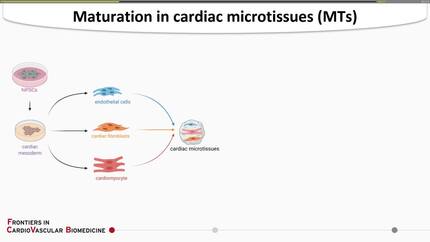
The cardiac sodium channel encoded by SCN5A gene undergoes fetal-to-adult isoform switch postnatally, regulated by alternative splicing. Various mutations in SCN5A associated with severe cardiac arrhythmia have been previously studied using cardiomyocytes derived from human induced pluripotent stem-cells (hiPSC-CMs), demonstrating the importance of a human cardiac cellular context for such analysis. Mutations in the adult isoform of SCN5A are however of difficult evaluation in hiPSC-CMs, because of their typical immature/fetal-like characteristics. Combining hiPSC-CMs in 3-dimensional microtissues together with hiPSC-derived cardiac fibroblasts and endothelial cells induced maturation in gene expression and functional properties, including electrophysiology.
We investigated whether the maturation promoted by the microtissue system could reveal the functional phenotype of a mutation in the adult isoform of SCN5A.
We derived hiPSC-CMs from a cardiac arrhythmia patient carrying two compound mutations in SCN5A: p.W156X in exon 4 and p.R225W in the adult splicing variant of exon 6 (exon 6B). Using CRISPR/Cas9, we corrected exon 4 mutation to investigate specific effects of exon 6B mutation on sodium current by single-cell patch clamp. HiPSC-CMs were matured in tricell-type cardiac microtissues and analysed after dissociation. The mechanism underlying exon 6B expression was investigated by overexpressing or knocking-out the alternative splicing regulator MBNL1 in hiPSC-CMs.
ddPCR analysis showed low expression of exon 6B-containing transcripts in hiPSC-CMs, accompanied by no effect of exon 6B mutation on the sodium current. Instead, maturing hiPSC-CMs in cardiac microtissues promoted SCN5A exon 6B expression and revealed the contribution of both SCN5A mutations to the diseased cellular electrophysiology. MBNL1 was upregulated in microtissues and indeed its overexpression was sufficient to increase exon 6B levels in hiPSC-CMs, while lack of MBNL1 prevented the switch of SCN5A splicing isoforms.
Our data demonstrate that a maturation of hiPSC-CMs is required to express the adult SCN5A isoform. This was achieved in the microtissue system via upregulation of MBNL1, and allowed to reveal SCN5A mutation contributions, by dissecting changes in ionic current that cause adult arrhythmic disease phenotypes in humans.
Contributors


D Ward-Van Oostwaard
Author
G Kosmidis
Author
AO Verkerk
Author
CR Bezzina
Author
CL Mummery
Author
M Bellin
Author
You may be interested in