EDEM2 regulation of cardiac lipid metabolism in heart failure with preserved ejection fraction
Cardiovascular Research


Abstract
Type of funding sources: Foundation. Main funding source(s): British Heart Foundation
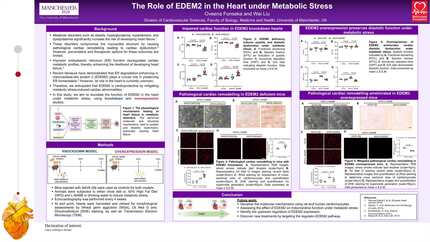
Heart failure with preserved ejection fraction (HFpEF) is the most predominant form of heart failure (HF) worldwide, one which confers substantial mortality and has no efficacious treatments. Lipid mishandling greatly contributes to the pathophysiology of HFpEF, nevertheless, the key mechanistic features regulating cardiac lipid overload remain poorly understood. EDEM2 plays a crucial role in the ER-associated degradation (ERAD) pathway. Recent studies show that ERAD-associated proteins are implicated in cellular lipid homeostasis, however, the role of EDEM2 is cardiac lipid metabolism remains poorly understood. Here, we investigate the mechanisms by which EDEM2 regulates cardiomyocyte lipid metabolism and cardiac dysfunction in HFpEF.
In vivo two-hit disease model of HFpEF, Adeno-associated virus serotype 9 (AAV9)-mediated cardiac-specific gene overexpression, tail-cuff blood pressure recordings, echocardiography, histology and qPCR.
Under HFpEF inducing conditions, AAV9-Gfp injected mice (as controls) displayed an increased E/A ratio and IVRT both of which are indicative of diastolic dysfunction. Conversely, cardiac-specific EDEM2 overexpression prevented diastolic dysfunction in mice subjected to HFpEF conditions. Systolic function remained unchanged between groups. Interestingly, EDEM2 overexpression reduced myocardial neutral lipid accumulation and prevented severe oxidative stress and cardiac pathological remodeling. More importantly, although genes participating in fatty acid uptake and lipid droplets synthesis in the heart were comparable between AAV9-Gfp and AAV9-EDEM2 groups, those involved in lipolysis and fatty acid oxidation were upregulated in mice with cardiac-specific EDEM2 overexpression.
Cardiomyocyte-specific EDEM2 overexpression mitigates myocardial steatosis in a two-hit murine model of HFpEF, likely through enhancing fatty acid utilisation in the myocardium.
Contributors

R Raja
Author
You may be interested in