Circulating progenitor cells are associated with plaque progression and long-term outcomes in heart transplant patients
Cardiovascular Research


Abstract
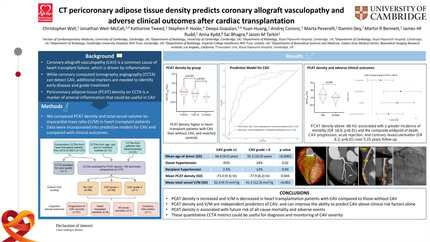
Circulating progenitor cells (CPCs) play a role in vascular repair and plaque stability, while osteocalcin (OC) expressing CPCs have been linked to unstable plaque and adverse cardiovascular outcomes. However, their role in cardiac allograft vasculopathy (CAV) has not been elucidated. This cohort study aimed to investigate the contribution of CPCs on CAV progression and cardiovascular events after heart transplantation.
A total of 80 heart transplant patients (mean age 55 ± 14 years, 72% male) undergoing annual intravascular ultrasound (IVUS) had fresh CPCs marked by CD34, CD133, and OC counted in peripheral blood using flow cytometry, on the same day as baseline IVUS. CAV progression was assessed by IVUS as the change (Δ) in plaque volume divided by segment length (PV/SL), adjusted for the time between IVUS measurements [median 3.0, interquartile range (2.8–3.1) years] and was defined as ΔPV/SL that is above the median ΔPV/SL of study population. Major adverse cardiac events (MACEs) were defined as any incident of revascularization, myocardial infarction, heart failure admission, re-transplantation, stroke, and death. Patients with higher CD34+CD133+ CPCs had a decreased risk of CAV progression [odds ratio 0.58, 95% confidence interval (CI) (0.37–0.92),
Lower levels of CD34+CD133+ CPCs are associated with plaque progression and adverse long-term outcomes in patients who underwent allograft heart transplantation. In contrast, higher circulating OC+ levels are associated with adverse long-term outcomes. Thus, CPCs might play a role in amelioration of transplant vasculopathy, while OC expression by these cells might play a role in progression.
Contributors

Ilke Ozcan
Author
Michel T Corban
Author
Ali Ahmad
Author
Darrell Loeffler
Author
David Morse
Author
Lilach O Lerman
Author
Sudhir S Kushwaha
Author
You may be interested in