Oral Presentation No. 69
Chronotropic incompetence: still a suitable indicator?
Cardiovascular Research


Abstract
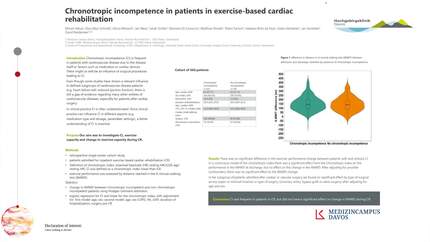
Chronotropic incompetence (CI) is defined as the inability to increase heart rate (HR) in response to increased activity. It is common in patients (pts) with cardiovascular (CV) disease, being a predictor of major adverse CV events; however, its importance is often underestimated in clinical practice.
Evaluate the prognostic value of CI in pts with known coronary artery disease (CAD) who performed Bruce protocol treadmill testing.
Unicentric, retrospective analysis of consecutive pts with known CAD who underwent Bruce protocol treadmill testing between 2009 and 2010. Chronotropic index (ChI) was calculated as:(peak HR–resting HR)/(220–age–resting HR). CI was defined as ChI < 80% (< 62% in pts prescribed with beta-blockers). Pts were divided in two groups-G1: CI and G2: normal chronotropic response. Events were defined as:
A total of 471 pts were included (87.3% male, mean age 69 ± 9.8 years). Mean follow-up was 9.7 years. The groups were similar regarding sex, age, body mass index, diabetes, arterial hypertension, dyslipidemia, MI and left ventricle ejection fraction (
CI is a simple an easily available parameter that shows a clear association with CV mortality in a long-term follow-up of pts with CAD.
Contributors

Isabel Cruz
Author
Bruno Bragança
Author
Inês Oliveira
Author
Rafaela Lopes
Author
Rui Santos
Author
Conceição Queirós
Author
Aurora Andrade
Author
You may be interested in