Poster No. 122 Predicting the rate of progressive dilation by wall shear stress in bicuspidaortic valve patients
Cardiovascular Research


Abstract
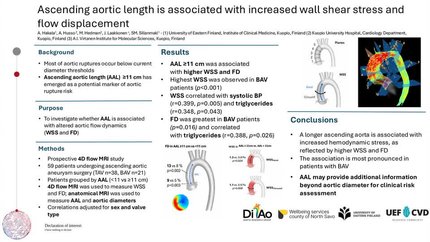
Despite the high prevalence of ascending aorta (AAo) dilation in bicuspid aortic valve (BAV) patients there is limited evidence of dilation aetiology. Several cross-sectional studies pointed to a role for wall shear stress (WSS), but this hypothesis has not been tested. Recently, a technique for 3D-maps of aortic growth from two contrast-enhanced computed tomography angiograms (CTA) was presented and validated. We aim to test if local WSS predicts local dilation rates in BAV patients.
Forty BAV patients free from aortic valve disease and previous relevant interventions underwent a baseline 4D flow CMR followed by two CTA. WSS, and its axial and circumferential components, and growth rate (GR) were computed at 64 standardized regions in the ascending aortic (AAo). A two-tailed p-value < 0.05 was considered statistically significant.
Patients were relatively young (51 ± 13 yeas) and follow-up duration was 44.8 ± 2.6 months. Growth rate was heterogeneous in the AAo, with fastest progression located in the outer mid AAo region and in the inner region of the proximal-mid AAo. WSS magnitude and WSS axial component were maximum in the right region of the mid AAo while circumferential WSS was highest in the outer region of the mid AAo, the region experiencing fastest growth. Significant associations between GR and circumferential WSS were located in the regions with fastest progressive dilation, while WSS magnitude and its axial component resulted in limited predictive capacity. In conclusion, circumferential WSS is related to fast progressive dilation in BAV patients.
Contributors

Jose Rodriguez-Palomares
Author
Gisela Teixidó-Turà
Author
Filipa Valente
Author
Laura Gutierrez
Author
Lydia Dux-Santoy
Author
Aroa Ruiz-Muñoz
Author
Teresa Gonzalez-Alujas
Author
Augusto Sao-Aviles
Author
Arturo Evangelista
Author
Ignacio Ferreira-Gonzalez
Author
Juan Garrido-Oliver
Author
Andrea Guala
Author
Kevin Johnson
Author
Oliver Wieven
Author
Laura Galian
Author
You may be interested in