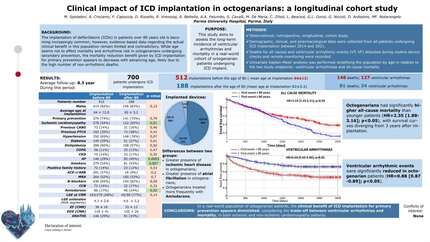
Poster No. 025 Survival in octogenarians receiving implantable cardiac defibrillators: a single centre experience
Cardiovascular Research


Abstract
Although the efficacy of implantable cardiac defibrillator (ICD) in preventing sudden cardiac death is well established in studies, patients ≥ 80 years are poorly represented, causing a paucity of data on outcomes in this subgroup.
In our single-centre retrospective study, data pertaining to patients > or = 80 years of age at device implant (
Mean age of the cohort was 83.1 ± 3 years, with 85% (
ICD therapy is a well-tolerated intervention and may confer survival benefits in elderly patients, provided careful selection criteria are implemented. Advanced chronological age alone should not unduly influence the decision for ICD selection for survival benefit. There is an imperative for greater representation of this cohort in future trials.
Contributors

Jebby Kuriakose
Author
Nitish Behary Paray
Author
Nikolaos Spinthakis
Author
Mohammad Saddam Jeelani
Author
You may be interested in