Preoperative depression or anxiety and late new-onset atrial fibrillation after cardiac surgery: an observational cohort study
EHJ - Open


Abstract
The aim was to study the association between preoperative depression or anxiety and incidence of late new-onset atrial fibrillation in patients undergoing cardiac surgery.
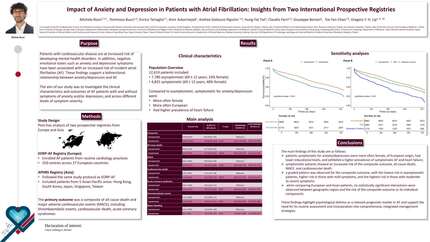
Data from five national registers including 44 338 patients who underwent primary cardiac surgery in Sweden between 2006 and 2020 were used, excluding those with a prior diagnosis of atrial fibrillation. Follow-up for atrial fibrillation occurred >30 days after surgery. Cox regression models were used to estimate the association between preoperative depression or anxiety and new late-onset atrial fibrillation in the total study population and according to sex and age categories. In total, 1037 (12%) of the patients with preoperative depression or anxiety, and 5036 (14%) of those without, developed late new-onset atrial fibrillation following cardiac surgery. Patients with depression or anxiety had an increased risk of developing atrial fibrillation after cardiac surgery [adjusted hazard ratio (aHR) 1.09; 95% confidence interval (CI) 1.01–1.17]. Sex-specific analysis showed that men with depression or anxiety had an increased risk of late new-onset atrial fibrillation (aHR 1.14; 95% CI 1.05–1.25), whereas this increased risk was not observed in women (aHR 1.00; 95% CI 0.89–1.13).
Patients with preoperative depression or anxiety undergoing primary cardiac surgery had an increased risk of late new-onset atrial fibrillation. This association was predominantly observed in men under 75 years of age. Routine screening for depression and anxiety can identify patients at risk. Comprehensive care, including mental health support, lifestyle changes, and medication management, may reduce the risk of late new-onset atrial fibrillation.
Contributors

Malin Stenman
Author
Veronica Jackson
Author
Josefin Särnholm
Author
Linn Pettersson
Author
Ulrik Sartipy
Author
Susanne J Nielsen
Author
Salvatore De Rosa
Author
You may be interested in