Balloon shaft fracture, deflation failure, and intracoronary entrapment: a stepwise percutaneous bailout
European Heart Journal - Case Reports


Abstract
Balloon catheter fracture during percutaneous coronary intervention (PCI) is rare but potentially catastrophic. The literature describes three distinct forms: shaft fracture, undeflatable balloon, and entrapped balloon. Published bailout strategies typically address each problem in isolation; however, no specific guidance exists when multiple forms occur simultaneously.
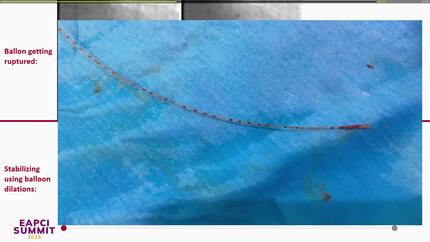
A 62-year-old man with multivessel coronary disease underwent staged PCI of a left circumflex–obtuse marginal bifurcation. During lesion preparation, a reused semi-compliant balloon (2.5 × 14 mm) fractured after multiple inflations, leaving an inflated, entrapped balloon fragment at the bifurcation with impaired antegrade flow. A stepwise percutaneous bailout was performed: (1) length comparison with an intact reference balloon suggested that a long fragment was partly retained inside the guiding catheter; (2) a guide extension catheter was advanced to displace the fragment distally, achieving passive deflation and restoring flow; and (3) the deflated fragment was retrieved using a 2.0 mm trapping balloon straddling the tip of the guiding catheter. The procedure was completed successfully with stenting, and the patient recovered uneventfully.
Sequential management converted a high-risk situation into a tractable single problem. Distal displacement of the inflated fragment relieved ischaemia before any retrieval attempt was made. Trapping with a second balloon straddling the guide catheter tip may improve grip when the fragment partly protrudes from the guiding catheter.
Contributors


Son Truong Do Chau
Author
Dzan Horozic
Author
Alexandru Patrascu
Author
Jan Henzel
Author
Deepti Ranganathan
Author
You may be interested in