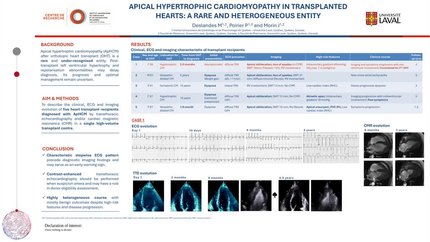
Right ventricular apical hypertrophic cardiomyopathy with asymmetric left ventricular septal involvement decades after heart transplant: a case report
European Heart Journal - Case Reports


Abstract
Long-term heart transplant (HT) survivors are an expanding population at risk for late, underrecognized complications. Hypertrophic cardiomyopathy developing in the cardiac allograft is exceptionally rare, and right ventricular involvement complicates risk stratification for sudden cardiac death.
A 30-year-old woman who underwent heart transplantation at 5 weeks for hypoplastic left heart syndrome was found to have right ventricular apical hypertrophy on surveillance transthoracic echocardiography. Sixteen months later, echocardiography demonstrated worsening right ventricular apical hypertrophy and new asymmetric left ventricular septal hypertrophy, without outflow tract obstruction. Cardiac magnetic resonance confirmed right ventricular apical hypertrophy (22 mm) extending into asymmetric septal hypertrophy (15 mm) with patchy late gadolinium enhancement involving approximately 30% of the myocardial mass, consistent with right ventricular apical variant hypertrophic cardiomyopathy with asymmetric left ventricular septal involvement. She remained asymptomatic. Given the extensive late gadolinium enhancement burden, a subcutaneous implantable cardioverter-defibrillator was placed for primary prevention of sudden cardiac death. She remains asymptomatic 16 months later with no device-detected arrhythmias.
To our knowledge, this is the first report of right ventricular apical hypertrophic cardiomyopathy with left ventricular septal involvement in a HT recipient. Cardiac magnetic resonance characterized structurally significant but clinically silent disease, supporting a lower threshold for its use when surveillance echocardiography is abnormal after transplantation. Extensive late gadolinium enhancement in hypertrophic cardiomyopathy involving the right ventricle may warrant greater weight in sudden cardiac death risk stratification than current guidelines specify.
Contributors

Andrew Wilbur
Author
Arjun Sinha
Author
Roberta Catania
Author
Albert Lin
Author
Anjan Tibrewala
Author
Asmaa el Abbady
Author
Martin Altersberger
Author
Deepti Ranganathan
Author
You may be interested in