Late pacemaker lead perforation in acute myopericarditis: a case report
European Heart Journal - Case Reports


Abstract
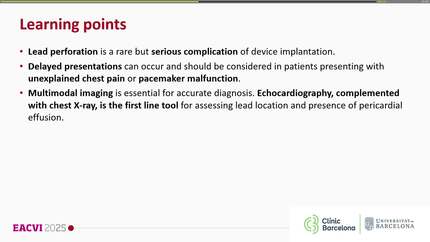
Although myocarditis can be associated with ventricular wall thinning, aneurysm, and free wall rupture, late pacemaker lead perforation in myopericarditis is previously unreported.
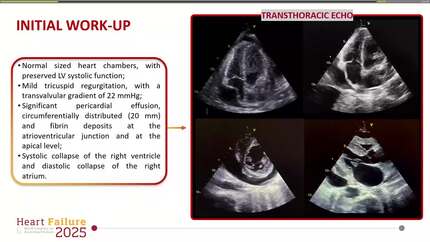
A 71-year-old man with a dual-chamber pacemaker placed 7 years prior presented with acute myopericarditis 2 months after atrial fibrillation ablation, left ventricular ejection fraction of 52%, and small pericardial effusion. Cardiac magnetic resonance (CMR) revealed focal late gadolinium enhancement (LGE) of the basal inferolateral wall of the left ventricle. Diffuse, circumferential pericardial LGE was present around the left and right ventricle with small effusion. One month later, he returned with worsening chest pain, decompensated heart failure, moderate pericardial effusion, and effusive-constrictive physiology. Echocardiography identified a new pacemaker lead perforation. Following device revision, he was discharged on colchicine, non steroidal anti-inflammatory drugs (NSAIDs), and empagliflozin. On follow-up, ejection fraction normalized, and constrictive physiology and cardiac inflammation resolved.
Late lead perforation is a rare complication of myopericarditis and should be considered in patients who re-present with progressive pericardial effusion and decompensation after initial improvement.
Contributors

Tyler J Canova
Author
Sushil Allen Luis
Author


Abdelsalam Bensaaud
Author
Luis Antonio Moreno-Ruiz
Author
Pawan Daga
Author
Deepti Ranganathan
Author
You may be interested in