Role of 3D TTE and TEE in predicting BMV outcome
European Heart Journal Supplements


Abstract
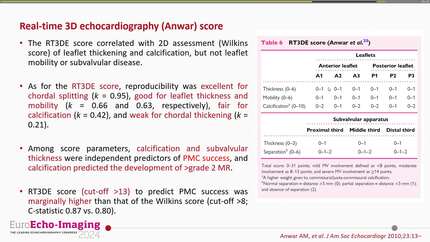
The aim of this study is to find out quantitative morphological parameters that could be helpful in prediction of success and development of de novo or worsening MR after PBMV, and to define the role of 3D TEE in mitral valve assessment.
This prospective cohort study was conducted on 85 patients, age >18 years old, of both sexes, presented to (NHI) and Fayoum University hospital with isolated severe rheumatic MS with Wilkins' score <12, and nonexisting or mild mitral insufficiency; who then underwent PBMV in the period from August 2021 to May 2023. Exclusion criteria: Any contraindication or unfavorable clinical characteristics for PMV or for TEE.
The ROC curve analysis revealed noteworthy insights into the predictive capabilities of the measured parameters. In the context of 2-D TEE measurements, the P/A LLR, CAR, and DH emerged as robust predictors of procedural success. The high Area Under the Curve (AUC) values for these parameters (0.931, 0.929, and 0.946, respectively) indicated their strong discriminatory power. Furthermore, the significant p-values (<0.001) underscored the statistical significance of these associations. These findings suggest that these 2-D TEE parameters can serve as valuable tools for anticipating the success of the targeted cardiac intervention. The 3-D TEE measurements also exhibited promising predictive potential. Notably, P/A LLR, CAR, and Ca score demonstrated varying levels of accuracy as predictors of procedural success. While all three parameters exhibited strong AUC values (0.929, 0.930, and 0.863, respectively), the significance of their associations (
In conclusion, the study's findings underscore the potential of echocardiographic measurements as predictive markers for BMV procedural success. 3D TEE has added value over 2D TEE. The utility of 3-D TEE measurements is complementing the predictive capacity of 2-D TEE parameters.
Contributors

Asmaa Elbagoury
Author
Hytham Soliman Ghareeb
Author
Ashraf Ahmed
Author
Mahmoud Elmallwany
Author
Mohamed Ahmed Oraby
Author
Khaled Elkhashab
Author
You may be interested in