Drug-coated balloon angioplasty for complex coronary lesions: a real-world experience
European Heart Journal Supplements


Abstract
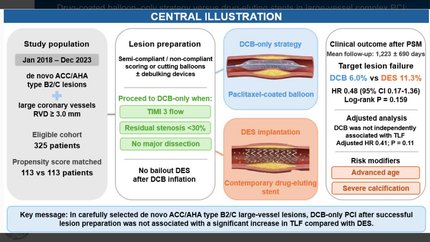
Drug-coated balloons (DCBs) offer a metal-free revascularization option for selected coronary lesions, but real-world data remain limited. We evaluated procedural and 1-year outcomes of DCB angioplasty.
This retrospective single-center study included patients undergoing PCI with paclitaxel-coated DCBs (2023–2025). Clinical, angiographic, and procedural data were analyzed. Lesions were prepared with 1:1 semi/non-compliant balloons. The primary endpoint was 1-year MACE (all-cause mortality, MI, TVR, or stroke).
76 patients (mean age 62 years; 73.7% male) were treated; 67.1% diabetics and 73.7% hypertensive. Lesions were de novo (85.5%), ISR (10.5%), SVG-ISR (2.6%), or de novo SVG (1.3%); 40.8% bifurcation, 28.9% calcified, and 47.3% involved large vessels. DCB-only PCI was performed in 89.5% and hybrid DCB-stent PCI in 10.5%. Mean minimal lumen diameter increased from 0.73 to 1.96 mm (acute gain 1.17 mm). Procedural success (residual stenosis <30% without flow-limiting dissection) was 87.2%; bailout stenting in 7.0% and dissections >Type B in 5.0%. At 1 year, TVR, MACE, and CVS mortality were 1.3, 7.8, and 1.3%, respectively. No MACE or TVR occurred in the hybrid group vs. 8.8 and 2.9% with DCB-only PCI. Increasing age, diabetes, and hypertension independently predicted MACE, whereas ISR treatment and greater acute luminal gain predicted lower risk.
DCB angioplasty achieved favorable procedural success and low 1-year adverse events in complex coronary lesions. Both DCB-only and hybrid strategies were feasible, supporting DCB-based revascularization in selected patients.
Contributors

Mishal Zehra
Author
Muhammad Tariq Farman
Author
Fazilat Akbar
Author
Abdul Bari Babar
Author
Omar Farooq Shaikh
Author
Erum Shahzadi Malik
Author
Hafsa Mahmood
Author
You may be interested in