Combined imaging of myocardial scar and fat using artificial intelligence-guided dual bright- and black-blood late gadolinium enhancement
European Heart Journal - Imaging Methods and Practice


Abstract
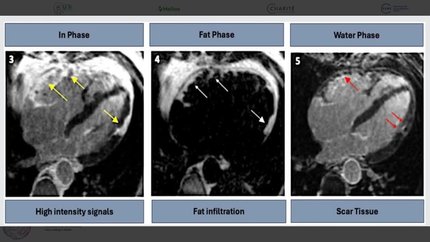
Characterization of myocardial scar and fat is clinically important for diagnosis, risk stratification, and procedural planning in cardiomyopathies. While black-blood late gadolinium enhancement (LGE) improves scar conspicuity, fat remains hyperintense and may confound interpretation. We aimed to develop and evaluate SPOT-DIXON, a dual bright- and black-blood LGE sequence with Dixon water-fat separation and artificial intelligence (AI)-guided analysis, enabling simultaneous and co-registered quantification of myocardial scar and intra- and extra-cardiac fat.
SPOT-DIXON alternates bright- and black-blood LGE preparations on consecutive heartbeats while acquiring dual-echo data for Dixon water-fat separation. Simulations, phantom experiments, and validations in a prospective cohort of 36 patients referred for cardiac magnetic resonance imaging were performed. An AI model automatically segmented the left ventricular (LV) wall on bright-blood water images, with contours propagation to scar and fat images. Simulations and phantoms confirmed preserved bright- and black-blood contrast and accurate water-fat separation. In patients, AI-based LV wall segmentation showed excellent agreement with manual delineation (global DICE = 84.4 ± 4.0%). SPOT-DIXON yielded higher scar volume, burden, and transmurality measurements than reference sequences, while LV wall volume was similar between sequences. Novel quantitative metrics, including intramyocardial fat burden expressed relative to scar mass, were feasible only with SPOT-DIXON. Acquisition times were comparable across sequences (5 min 55 s ± 2 min 17 s), while AI-based analysis substantially reduced post-processing time to 2.1 ± 0.7 s.
AI-guided SPOT-DIXON enables simultaneous, co-registered assessment of myocardial scar and fat within a single LGE acquisition. This approach overcomes key limitations of current workflows and introduces novel quantitative markers of fibrofatty remodelling with potential clinical relevance in cardiomyopathies.
Contributors

Kalvin Narceau
Author
Manuel Villegas-Martinez
Author
Théo Richard
Author
Victor de Villedon de Naide
Author
Thaïs Génisson
Author
Ewan Barel
Author
Michel Haïssaguerre
Author
Matthias Stuber
Author
Hubert Cochet
Author

You may be interested in