Inhaled nitric oxide use facilitated VA-ECMO weaning during ECPELLA support in a patient with a precapillary pulmonary vascular phenotype: a case report
European Heart Journal - Case Reports


Abstract
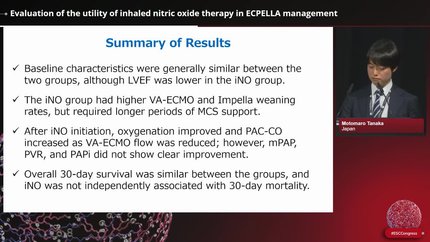
Combined support with veno-arterial extracorporeal membrane oxygenation (VA-ECMO) and a micro-axial flow pump (mAFP), termed ECPELLA, provides systemic circulatory support with left ventricular (LV) unloading in refractory cardiogenic shock. VA-ECMO weaning may nevertheless be difficult when pulmonary vascular afterload is increased despite adequate LV unloading. Inhaled nitric oxide (iNO) selectively reduces pulmonary vascular resistance (PVR), but its role in this setting remains unclear.
An 83-year-old woman with non-ST-segment elevation acute coronary syndrome underwent percutaneous coronary intervention. Persistent circulatory collapse required mAFP support followed by VA-ECMO. Despite adequate LV unloading, pulmonary artery catheterization showed low pulmonary artery catheter-derived cardiac output (PAC-CO), low pulmonary capillary wedge pressure, and high calculated PVR, suggesting increased pulmonary vascular afterload rather than residual LV congestion. VA-ECMO flow reduction caused hypotension. After administration of iNO at 40 ppm, PAC-CO increased from 1.2 to 1.5 L/min and calculated PVR decreased from 11.7 to 8.0 Wood units while mechanical circulatory support settings and ventilator settings remained unchanged. VA-ECMO was removed on Day 2 and the mAFP on Day 3. The patient nevertheless died on Day 4 from complications of severe lower-limb ischaemia.
A relative increase in PVR may hinder VA-ECMO weaning during ECPELLA support. iNO may facilitate device weaning in selected patients; however, a temporal association in a single case does not establish causality, clinical recovery, or a survival benefit.
Contributors

Motomaro Tanaka
Author
Takashi Unoki
Author
Hiroki Matsushita
Author
Keita Saku
Author
Junjiro Koyama
Author
Marie-Luise Dikou
Author
Hristijan Alagjozovski
Author
Deepti Ranganathan
Author
You may be interested in