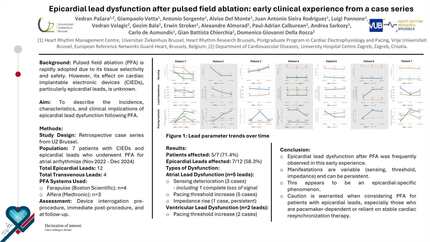
Device malfunction following epicardial pulsed field ablation using a focal dual energy ablation catheter in a patient with cardiac resynchronization therapy defibrillator: a case report
European Heart Journal - Case Reports


Abstract
Pulsed field ablation (PFA) is increasingly used, but experience with ventricular, and particularly epicardial, applications in patients with cardiac implantable electronic devices (CIEDs) remains limited.
A 49-year-old woman with LMNA- and SCN5A-associated cardiomyopathy, mildly reduced left ventricular ejection fraction (45%), and a cardiac resynchronization therapy defibrillator (CRT-D) presented with recurrent ventricular tachycardia (VT) and implantable cardioverter-defibrillator shocks. Previous endocardial VT ablation had revealed no relevant endocardial low-voltage substrate.
Repeat ablation was performed using a combined endo–epicardial approach. Epicardial mapping identified extensive low-voltage areas, with the best pace-map match at the basal lateral left ventricle. Ablation was performed using a focal dual-energy catheter with radiofrequency energy up to 40 W and PFA (2400 V).
Following epicardial PFA in proximity to the device generator and left ventricular lead, pacing abruptly changed from VVI 30/min to DDD 70/min. Initial attempts at device interrogation failed. After communication was restored, interrogation demonstrated that the CRT-D had reverted to factory settings. The device was successfully reset and reprogrammed. Further PFA near the LV lead or generator was avoided. Sensing, pacing thresholds, and lead impedances were preserved.
To our knowledge, this is the first report of a clinically relevant transient CIED malfunction temporally associated with epicardial ventricular PFA using a focal single-tip dual-energy ablation catheter. Although no permanent generator or lead dysfunction occurred, this observation highlights the potential for PFA–CIED interactions beyond conventional PFA workflows and across different catheter technologies.
Contributors

Rahin Wahedi
Author
Julia Vogler
Author
Stephan Willems
Author

Philipp Sommer
Author
Christian Sohns
Author
David Duncker
Author
Deepti Ranganathan
Author
You may be interested in