Pigtail catheter entrapment during post-dilation causing Sapien-3 Ultra RESILIA valve damage with severe intravalvular aortic regurgitation: a case report
European Heart Journal - Case Reports


Abstract
Acute prosthetic leaflet dysfunction after transcatheter aortic valve implantation (TAVI) is rare but potentially life-threatening. Catheter-induced leaflet trauma during post-dilatation is less well recognized.
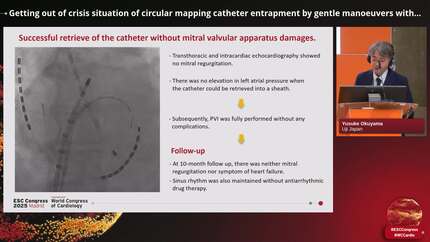
An 88-year-old woman with severe symptomatic aortic stenosis and high-risk aortic root anatomy—including a narrow sinus of Valsalva, low left coronary artery (LCA) height, and a small, calcified sinotubular junction—underwent elective TAVI with a 23-mm Sapien 3 Ultra RESILIA valve deployed with a 2-mL underfill under prophylactic LCA protection. Initial transthoracic echocardiography and aortography showed trivial paravalvular leak and preserved LCA flow. During post-dilatation, the distal balloon tip and Safari guidewire snagged the pigtail catheter, pulling it across the prosthesis and into the left ventricle. Unrecognized in a crowded fluoroscopic field, the catheter became trapped between the expanding balloon and the valve frame, causing focal leaflet injury and severe intravalvular aortic regurgitation with haemodynamic collapse. Emergent valve-in-valve implantation with a 20-mm Sapien 3 Ultra RESILIA under bilateral coronary protection resolved the regurgitation, but displaced leaflet tissue caused LCA ostial compromise requiring chimney stenting. The patient recovered uneventfully and remained stable at 30-day follow-up.
This case illustrates pigtail catheter entrapment during post-dilatation as a preventable cause of acute prosthetic leaflet damage and severe intravalvular regurgitation. It underscores the need for meticulous catheter management, critical reassessment of post-dilatation in older patients with trivial leak, and individualized valve platform and size selection in small, anatomically constrained aortic roots.
Contributors

Hiroyuki Ikezaki
Author
Naoki Sato
Author
Grigoris Karamasis
Author
Sara Corradetti
Author
Angelo Quagliana
Author
Michael Paukovitsch
Author
Deepti Ranganathan
Author
You may be interested in