A shift in the platelet lipidome correlates with platelet differentiation into distinct subfractions in patients with pulmonary embolism
Cardiovascular Research


Abstract
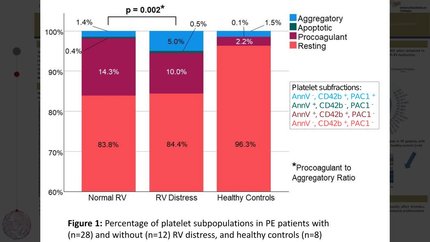
Severity of pulmonary embolism (PE) is significantly driven by right ventricular (RV) failure and thrombus composition, which possibly alters susceptibility towards therapy. Following platelet activation, platelets differentiate into different phenotypes, including a procoagulant and an aggregatory phenotype. Differentiation into these phenotypes is associated with changes in the platelet lipidome. Hence, we sought to investigate platelet subpopulations and the platelet lipidome in patients with acute PE and concomitant vs. absent RV distress.
We examined isolated platelets from 48 patients with acute PE. PE and RV distress were diagnosed with CT pulmonary angiogram (CTPA) and transthoracic echocardiography, respectively. We identified platelet subpopulations based on platelet surface exposure of CD42b, phosphatidylserine and GPIIb/IIIa using flow cytometry. Additionally, the platelet lipidome was characterized via HPLC-ESI-QTOF-MS/MS. In patients with RV distress, we found higher levels of aggregatory (
Specific stimuli can activate distinct metabolic programmes, leading to remodelling of the platelet lipidome that may influence the differentiation of platelets into separate phenotypic subpopulations in PE.
Contributors

Jessica Kristin Henes
Author
Tobias Harm
Author
Manuel Friedel
Author
Rebecca Stübenrath
Author
Zoi Laspa
Author
David Schaale
Author
Valerie Dicenta-Baunach
Author
Anne-Katrin Rohlfing
Author
Karin Müller
Author
Michal Droppa
Author
Zijing Xu
Author
Xiaoqing Fu
Author

Michael Laemmerhofer
Author
Meinrad Gawaz
Author
You may be interested in