Incremental prognostic value of late gadolinium enhancement in hypertrophic cardiomyopathy in a large contemporary cohort
Cardiovascular Research


Abstract
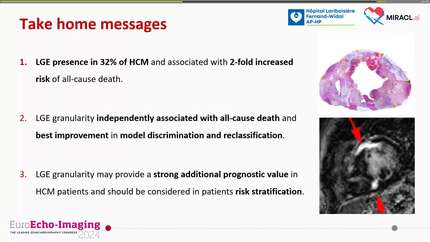
Extensive late gadolinium enhancement (LGE) is recognized in contemporary hypertrophic cardiomyopathy (HCM) risk assessment, but the prognostic value of lower quantitative thresholds remains debated. We aimed to evaluate whether quantitative LGE provides independent and incremental prognostic information beyond established clinical and phenotypic risk markers.
This large contemporary cohort included 3035 patients (median age 58 years, 57% men); 56% had LGE, including 242 (8%) with LGE > 10%. Most patients have obstructive hypertrophic cardiomyopathy (71%), 1498 (69%) of which subsequently underwent septal reduction therapy at a median of 43 days [interquartile range (IQR) 5–107) from the cardiac magnetic resonance (CMR) date (1485 myectomies and 13 alcohol septal ablations). Over a median of 8.8 years, 331 (11%) primary endpoints occurred [295 cardiovascular deaths (9.7%) and 36 appropriate implantable cardioverter–defibrillator discharges (1.3%)]. On multivariable Cox proportional hazards analysis [adjusted for standard clinical and CMR variables, higher %LGE (1.05 per 1% increase, 95% confidence interval 1.03–1.06;
In this large contemporary HCM cohort, quantitative LGE was independently associated with long-term adverse outcomes. LGE ≥10% identified patients at significantly higher risk, and incorporation of LGE improved discrimination beyond ESC and AHA/ACC risk assessment.
Contributors

Susan K Keen
Author
Stuti Shah
Author
Hesham Sheashaa
Author
Mohammed Abusafia
Author
Shada Jadam
Author
Simrat Kaur
Author
Andrew Gaballa
Author
Susan Ospina
Author
Katy Rutkowski
Author
Jay Ramchand
Author
Zoran B Popovic
Author
Maran Thamilarasan
Author
Nicholas G Smedira
Author
Paul Schoenhagen
Author
Bo Xu
Author
Michael Bolen
Author

You may be interested in