Stellate ganglion phototherapy for electrical storm during mechanical circulatory support in acute coronary syndrome: a case series
European Heart Journal - Case Reports


Abstract
Electrical storm (ES) during mechanical circulatory support (MCS) in the setting of acute coronary syndrome (ACS) represents a life-threatening condition driven by sympathetic hyperactivation and repolarization abnormalities. While stellate ganglion block is recognized as an effective autonomic modulation strategy for drug-refractory ventricular arrhythmias, its use may raise concerns regarding bleeding complications in patients receiving systemic anticoagulation. Stellate ganglion phototherapy (SGP) is a non-invasive alternative, but its clinical utility for ES under MCS remains unclear.
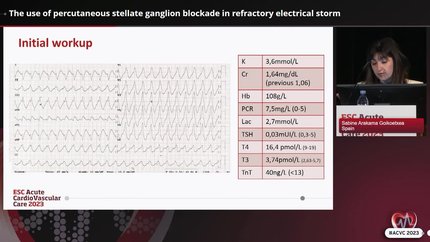
This case series describes two patients with drug-refractory ES complicating ACS during MCS management. Patient 1, a 78-year-old woman with cardiogenic shock, developed recurrent ventricular fibrillation (VF) with QT prolongation while on veno-arterial extracorporeal membrane oxygenation. Overdrive pacing caused haemodynamic deterioration, and conventional antiarrhythmic drugs failed. Following SGP initiation, no further VF requiring electrical shocks occurred. Extracorporeal membrane oxygenation was subsequently withdrawn. Patient 2, a 77-year-old man, developed recurrent torsades de pointes/VF with QT prolongation after left main revascularization under Impella support. Following SGP initiation, no further episodes requiring electrical shocks occurred. Impella was subsequently removed.
Stellate ganglion phototherapy may represent a non-invasive autonomic modulation strategy for drug-refractory ES in ACS patients requiring MCS. Although concomitant therapies and gradual recovery from myocardial ischaemia may have contributed to arrhythmia suppression, the temporal association suggests a potential contribution of SGP. Stellate ganglion phototherapy may serve as a bridge to recovery when invasive approaches pose additional challenges.
Contributors

Yuki Arakawa
Author
Takehiro Hashikata
Author
Yuki Ikeda
Author
Nobuhiro Sato
Author
Hidehira Fukaya
Author

Stefano Bordignon
Author
Niklas Schenker
Author
Boldizsar Kovacs
Author
Leo Bergau
Author
Michael Spartalis
Author
Deepti Ranganathan
Author
You may be interested in