Pheochromocytoma masquerading as fulminant myocarditis with marked interleukin-6 elevation: a case report
European Heart Journal - Case Reports


Abstract
Pheochromocytoma is a rare cause of cardiogenic shock with diverse cardiovascular manifestations. Although catecholamine-induced cardiomyopathy is well recognized, presentations closely resembling fulminant myocarditis are uncommon and diagnostically challenging. The role of cytokine-mediated inflammatory activation in such presentations is not well defined.
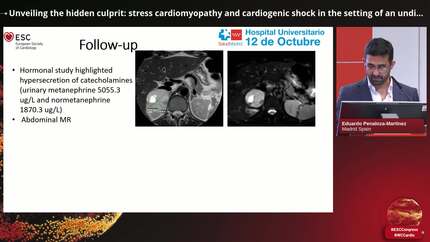
A previously healthy woman in her 30s presented with fever, ventricular arrhythmias, and severe left ventricular dysfunction, rapidly progressing to cardiogenic shock requiring venoarterial extracorporeal membrane oxygenation and Impella support. Fulminant myocarditis was initially suspected based on clinical, electrocardiographic, and biomarker findings, and immunomodulatory therapy was initiated. Although transient improvement was observed, endomyocardial biopsy showed minimal inflammatory infiltration. Subsequent computed tomography revealed a left adrenal mass, and biochemical testing confirmed markedly elevated catecholamines. Notably, interleukin-6 (IL-6) was also markedly elevated relative to C-reactive protein. Despite initiation of α-blockade, the patient developed recurrent haemodynamic collapse, necessitating emergency adrenalectomy. Pathological examination confirmed a necrotic pheochromocytoma, but the patient died of refractory multiorgan failure.
This case illustrates how pheochromocytoma can closely mimic fulminant myocarditis, with a risk of diagnostic anchoring. The coexistence of marked IL-6 elevation and catecholamine excess raises the possibility of concomitant inflammatory activation, although a causal role of IL-6 cannot be established. Recognition of this pattern is important to prompt reconsideration of endocrine aetiologies in myocarditis-like cardiogenic shock.
Contributors

Hiroshi Suzuki
Author

Giacomo Tini Melato
Author
Naoki Arima
Author
Alaeldin Addas
Author
Yuki Ikeda
Author
Yuka Tanizaki
Author
Tokutada Sato
Author
Sayuri Nii
Author
Deepti Ranganathan
Author
You may be interested in