One-minute heart rate recovery and clinical outcomes in transthyretin cardiac amyloidosis: incremental model fit beyond conventional CPET indices
EHJ - Open


Abstract
To assess the association of 1-min heart rate recovery (HRR1) with clinical outcomes and its incremental contribution to model fit beyond peak VO2 and ventilatory efficiency (VE/VCO2 slope) in transthyretin cardiac amyloidosis (ATTR-CM).
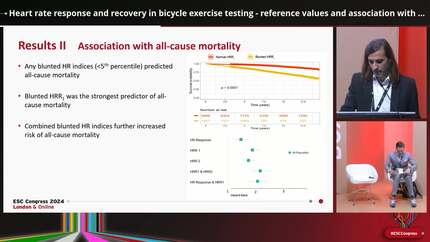
Consecutive adults with confirmed ATTR-CM undergoing symptom-limited cardiopulmonary exercise testing (CPET) were included in this single-centre observational study. During standardized active recovery at 24 W, HRR1 was defined as peak heart rate minus heart rate exactly 60 s after exercise. Cox proportional-hazards models evaluated all-cause mortality and the composite of mortality or first heart-failure hospitalization. Principal models adjusted for age, sex, peak VO2 and VE/VCO2 slope; NT-proBNP and National Amyloidosis Centre (NAC) stage were examined separately. Of 161 baseline patients, 11 with unverifiable heart-rate measurements were excluded, and exact HRR1 was available in 110. Mortality analysis included 105 patients with 33 deaths; composite-outcome analysis included 107 patients with 51 events. Median HRR1 was 15.5 bpm. In conventional CPET-adjusted models, each 10-bpm greater HRR1 was associated with lower hazards of mortality [hazard ratio (HR) 0.65, 95% confidence interval (CI) 0.44–0.95;
HRR1 remained associated with outcomes after CPET adjustment and improved model fit. Discrimination gains were modest; value beyond biomarker staging was unproven.
Contributors

Antonio Kösters
Author
Nikita Ermolaev
Author
Mahshid Eslami
Author
Leonhard Lichtblau
Author
Lisa Seilinger
Author
Stefanie Pahr
Author
Mariusz Grzeda
Author

Giuseppe Vergaro
Author
You may be interested in