Sex differences in detection of acute coronary syndrome culprit lesion using conventional and AI-enhanced coronary CT angiography
European Heart Journal - Cardiovascular Imaging


Abstract
Acute coronary syndrome (ACS) exhibits marked sex-related differences in clinical presentation and underlying pathophysiology. However, whether these differences translate into variations in culprit lesion prediction remains unclear. We investigated the sex-specific performance of conventional coronary computed tomography angiography (CCTA) and artificial intelligence-enabled quantitative coronary plaque and haemodynamic assessment (AI-QCPHA) for ACS culprit detection.
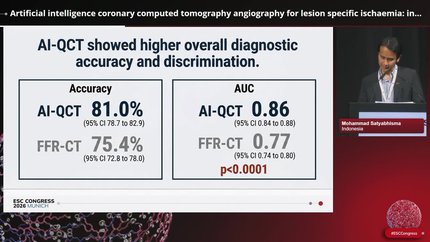
In this sub-study of the EMERALD II trial (NCT03591328), patients with ACS who underwent CCTA 1 month to 3 years prior to the event were analysed. Culprit and non-culprit lesions were defined by invasive coronary angiography at the time of ACS. Diagnostic performance of obstructive stenosis (Coronary Artery Disease-Reporting and Data System ≥ 3) and high-risk plaque (HRP) criteria was compared between women and men. Information gain-based feature selection identified sex-specific AI-QCPHA best predictors across five feature clusters, and their incremental predictive value was evaluated using receiver operating characteristics reported as area under the curve (AUC). A total of 351 patients (90 women, 261 men) with 2451 lesions were included. Conventional CCTA performed similarly across sexes for obstructive stenosis, whereas HRP differed by sex. AI-QCPHA identified the same best features for ACS culprit prediction in both sexes, and integration of these features improved discriminatory performance beyond conventional CCTA (women AUC 0.84 vs. 0.78,
AI-QCPHA enhances culprit lesion prediction in obstructive ACS beyond conventional CCTA in both sexes, supporting its potential role for improved culprit lesion discrimination.
Contributors

Hyun Jin Ahn
Author
Seokhun Yang
Author
Jae Wook Jung
Author
Sang-Hyeon Park
Author

Jinlong Zhang
Author
The Second Affiliated Hospital, Zhejiang University School of Medicine Hangzhou , China
Keehwan Lee
Author
Doyeon Hwang
Author
Kyu-Sun Lee
Author
Sang-Hoon Na
Author
Joon-Hyung Doh
Author
Chang-Wook Nam
Author
Tae Hyun Kim
Author
Eun-Seok Shin
Author
Eun Ju Chun
Author
Su-Yeon Choi
Author
Hyun Kuk Kim
Author
Young Joon Hong
Author
Hun-Jun Park
Author
Song-Yi Kim
Author
Mirza Husic
Author
Jess Lambrechtsen
Author
Jesper M Jensen
Author
Bjarne L Nørgaard
Author
Daniele Andreini
Author
Pal Maurovich-Horvat
Author
Bela Merkely
Author
Martin Penicka
Author
Bernard de Bruyne
Author
Abdul Ihdayhid
Author
Brian Ko
Author
Georgios Tzimas
Author
Jonathon Leipsic
Author
Javier Sanz
Author
Mark G Rabbat
Author
Farhan Katchi
Author
Moneal Shah
Author
Nobuhiro Tanaka
Author
Ryo Nakazato
Author
Taku Asano
Author
Mitsuyasu Terashima
Author
Hiroaki Takashima
Author
Tetsuya Amano
Author
Yoshihiro Sobue
Author
Hitoshi Matsuo
Author
Hiromasa Otake
Author
Takashi Kubo
Author
Masahiro Takahata
Author
Takashi Akasaka
Author
Teruhito Kido
Author
Teruhito Mochizuki
Author
Hiroyoshi Yokoi
Author
Taichi Okonogi
Author
Tomohiro Kawasaki
Author
Koichi Nakao
Author
Tomohiro Sakamoto
Author
Taishi Yonetsu
Author
Tsunekazu Kakuta
Author
Yohei Yamauchi
Author
Charles A Taylor
Author
Jeroen J Bax
Author
Peter H Stone
Author

Jagat Narula
Author
University of Texas Health Science Center At Houston Houston , United States of America

Leslee J Shaw
Author
Icahn School of Medicine at Mount Sinai New York City , United States of America
You may be interested in