Trends in mortality, heart transplantation, and left ventricular assist device use in advanced heart failure between 2003 and 2022: data from the Swedish Heart Failure Registry
European Journal of Heart Failure


Abstract
Advanced heart failure (AdvHF) remains a major clinical challenge, yet contemporary epidemiological real-world data on AdvHF patients are limited. The aim was to assess 20-year trends in clinical characteristics, outcomes, and use of left ventricular assist devices (LVAD) and heart transplantation (HTx) in patients with AdvHF and reduced ejection fraction (AdvHFrEF) in Sweden.
Between 2003 and 2022, 5323 patients (median age 76 [IQR 68–82], 23% females) included in the Swedish HF Registry met adapted ESC-HFA criteria for AdvHF (NYHA III–IV, EF <30%, ≥1 HF hospitalization ≤6 months). Of these, 29% were eligible for AdvHF therapies (median age 63 [IQR 57–67] years, 18% females) according to the following additional criteria: ≤70 years old, no dialysis within ≤5 years, no active cancer within ≤3 years.
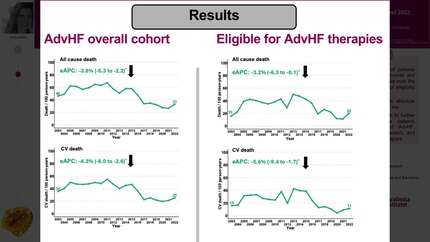
Unadjusted temporal trends in 1-year outcomes (all-cause, CV and non-CV death, HTx, and LVAD implantation) were presented as estimated annual percent change (eAPC). 1-year all-cause mortality declined significantly in the overall cohort (eAPC −3.8; 95%CI −5.3 to −2.2) as well as in patients eligible for AdvHF therapies (eAPC −3.2; 95%CI −6.3 to −0.1) over the study period. These improvements were largely driven by reductions in CV mortality (overall cohort: eAPC −4.3; 95%CI −6.0 to −2.6; eligible cohort: eAPC −5.6, 95%CI −9.4 to −1.7). Use of LVAD significantly increased over the study period, while HTx showed a modest but non-significant rise.
In a large nationwide cohort, all-cause and CV-mortality among AdvHFrEF patients markedly declined over the past 20 years, potentially reflecting improvements in treatments. Despite progress, significant opportunities remain to improve access to and adoption of advanced therapies.
Contributors

Federica Guidetti
Author
Lina Benson
Author

Christian Basile
Author
Alessandro Villaschi
Author
Davide Stolfo
Author
Camilla Hage
Author
Valeria Valente
Author
Francesca Musella
Author
Michael Melin
Author

Lars H Lund
Author
Oscar Braun
Author
Marco Metra
Author
Guillame Baudry
Author

You may be interested in