Real-world implementation of AI-assisted PERT-workflow and its association with care processes and budget impact: a retrospective cohort study
European Heart Journal - Digital Health


Abstract
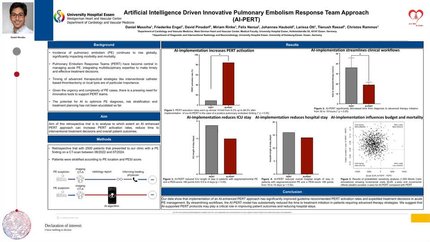
Pulmonary embolism (PE) remains a major cause of morbidity and mortality. In intermediate-high and high-risk PE, timely escalation beyond anticoagulation is critical, yet real-world pathways are often delayed. Pulmonary embolism response teams (PERTs) improve decision-making, but activation remains inconsistent. Whether artificial intelligence (AI)-enabled triage strengthens PERT and improves acute PE care has not been elucidated so far.
We retrospectively screened 2500 patients presenting to our university hospital with a symptomatic central or segmental PE between 08/2022 and 07/2024. Clinical and economic outcomes were compared during a 1-year timeframe before and after implementation of an AI algorithm that analyses CT scans, flags suspected PE, and supports PERT triage. 424 patients met inclusion criteria. AI-supported triage increased PERT activation from 9.2% to 84.5% (
Implementation of an AI-supported PERT workflow was associated with significant improvements in PE care processes, including higher PERT activation rates and shorter diagnostic and treatment intervals. Numerical reductions in mortality, hospital/ICU length-of-stay did not reach statistical significance. The exploratory budget impact model suggested potential cost savings, mainly driven by trends in reduced resource utilization; however, these findings require prospective validation using adequately powered clinical endpoints.
Contributors

Daniel Messiha
Author
Felix Nensa
Author
Johannes Haubold
Author
David Pinsdorf
Author
Michael Forsting
Author
Friederike Engel
Author
Fadi Al-Rashid
Author
Olga Petrikhovich
Author
Ramtin Knuschke
Author

Julia Lortz
Author
University of Duisburg-Essen - West-German Heart and Vascular Centre Essen , Germany
Tienush Rassaf
Author

Christos Rammos
Author
University of Duisburg-Essen - West-German Heart and Vascular Centre Essen , Germany
You may be interested in