Long-term mortality, cardiovascular events, and bleeding in stable patients 1 year after myocardial infarction: a Danish nationwide study
European Heart Journal


Abstract
Outcomes after myocardial infarction (MI) improved during recent decades alongside better risk factor management and implementation of guideline-recommended treatments. However, it is unknown whether this applies to stable patients who are event-free 1 year after MI.
Using nationwide Danish registries, we included all patients with first-time MI during 2000–17 who survived 1 year free from bleeding and cardiovascular events (
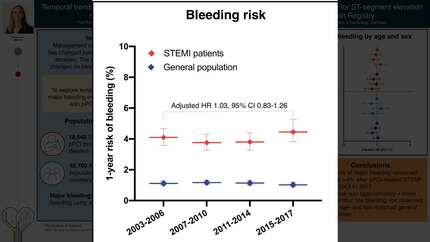
For patients who were event-free 1 year after MI, the long-term risks of mortality, cardiovascular events, and bleeding decreased significantly, along with an improved use of guideline-recommended treatments between 2000 and 2017. In the most recent period, 1 year after MI, the risk of additional events was lower than previously reported.
Contributors


Anne-Marie Schjerning
Author
Lærke Smedegaard
Author
Mette Gitz Charlot
Author
Pauline B Ravn
Author
Anne Christine Ruwald
Author
Emil Fosbøl
Author

Christian Torp-Pedersen
Author
Morten Schou
Author
Thomas Gerds
Author
Gunnar Gislason
Author
Thomas S G Sehested
Author
You may be interested in