Conservative management of a dislodged leadless pacemaker wedged in the pulmonary artery assessed by pulmonary perfusion scintigraphy: a case report
European Heart Journal - Case Reports


Abstract
Leadless pacemakers reduce complications associated with conventional transvenous systems; however, device dislodgement with pulmonary artery embolization is a rare complication unique to leadless pacemakers. Although prompt retrieval is generally recommended, retrieval from the pulmonary artery may carry procedural risks, particularly in elderly or high-risk patients.
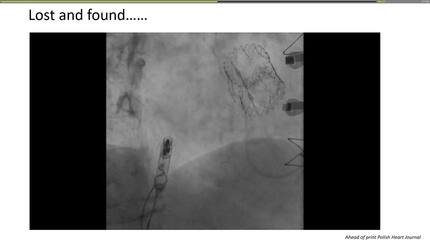
An 84-year-old woman with complete atrioventricular block underwent implantation of a leadless pacemaker. Although the pacing threshold was favourable, the R-wave amplitude was low, and unstable device movement was observed after tether release, suggesting inadequate fixation. Two hours after implantation, pacing failure occurred, and chest radiography showed migration of the device into the right pulmonary artery. The following day, the device migrated to the left posterior basal segmental pulmonary artery and remained stably wedged. Because of the risk associated with retrieval, conservative management was selected, and a transvenous pacemaker was implanted. Serial lung perfusion scintigraphy demonstrated right-to-left perfusion distributions of 60.5% vs. 39.5% at 10 days, 59.1% vs. 40.9% at 3 months, and 58.5% vs. 41.5% at 1 year, without progressive deterioration in left lung volume. The patient remained asymptomatic over 3 years of follow-up.
This case illustrates that conservative management may be feasible in carefully selected high-risk patients when an embolized leadless pacemaker is stably wedged within the pulmonary artery. Serial pulmonary perfusion scintigraphy may provide objective evidence of preserved pulmonary perfusion and support long-term follow-up after conservative management.
Contributors

Takanori Arimoto
Author
Daisuke Kutsuzawa
Author
Naoaki Hashimoto
Author
Ken Watanabe
Author
Masafumi Watanabe
Author
Deepti Ranganathan
Author
Rami Riziq Yousef Abumuaileq
Author
Deepti Ranganathan
Author
You may be interested in