Potassium-increasing regimens in patients at high risk of ventricular arrhythmias: a prespecified observational analysis of the randomized POTCAST trial
EP Europace Journal


Abstract
The POTCAST trial (
We studied 600 control participants and 572 intervention participants who completed potassium up-titration in POTCAST. Participants in the intervention arm were categorized according to treatment after plasma-potassium up-titration into (i) mineralocorticoid-receptor antagonists (MRAs) monotherapy, (ii) potassium-supplement monotherapy, or (iii) combination therapy with both. The primary endpoint was a composite of sustained ventricular arrhythmia, appropriate ICD therapy, hospitalization for arrhythmia or heart failure, or all-cause mortality. Safety outcomes included death and electrolyte/renal disturbances.
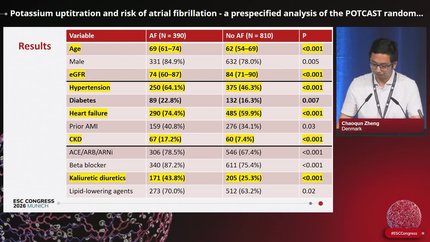
After 6 months, plasma potassium increased from 4.12 to 4.27 mmol/L (
Treatment with MRA, potassium supplements, or both increased potassium levels. All regimens were associated with numerically lower endpoint rates than controls. We detected no statistically significant differences in endpoints or safety between regimens.
Contributors

Elisabeth Margrethe Danielsen
Author
Rigshospitalet - Copenhagen University Hospital Copenhagen , Denmark

Emil Anton Frandsen
Author

Tharsika Sakthivel
Author
Kasper Karmark Iversen
Author
Helle Skovmand Bosselmann
Author
Niels Risum
Author
Henning Bundgaard
Author
Christian Jøns
Author
You may be interested in