Acute deoxygenation during M-TEER: a note of caution
European Heart Journal - Imaging Methods and Practice


Abstract
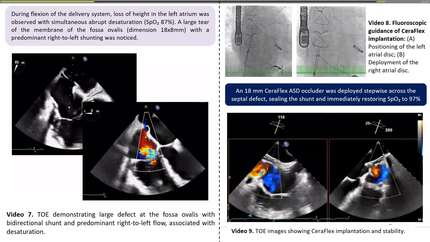
Right-to-left (R-L) shunting through an iatrogenic atrial septal defect (iASD) after mitral transcatheter edge-to-edge repair (M-TEER) is a rare but potentially life-threatening complication. We aimed to identify factors associated with clinically relevant R-L shunting requiring emergency iASD closure.
We retrospectively analysed 444 consecutive patients undergoing successful M-TEER between 2017 and 2026. Clinical, echocardiographic, and invasive haemodynamic parameters were compared between patients requiring emergency iASD closure and the remaining cohort. Six patients (1.3%) required emergency iASD closure due to R-L shunting and acute deoxygenation. All presented with severe tricuspid regurgitation, RV dilatation, and impaired RV function. Following M-TEER, right atrial pressure exceeded left atrial pressure in five patients. Compared with controls, affected patients demonstrated reduced tricuspid annular plane systolic excursion (15 ± 2 vs. 19 ± 4 mm), fractional area change (FAC) (27 ± 5% vs. 43 ± 6%), and RV free wall strain (−13 ± 2% vs. −22 ± 5%). Echocardiography underestimated invasively measured systolic pulmonary artery pressure (25.8 vs. 40.3 mmHg;
Severe tricuspid regurgitation, RV dysfunction, and elevated right atrial pressure may identify patients at risk for clinically relevant R-L shunting after M-TEER. Comprehensive RV assessment, including FAC and strain, combined with invasive hemodynamic evaluation, may improve risk stratification and facilitate timely iASD closure.
Contributors

Bernhard Unsöld
Author

Can Martin Sag
Author
Christine Meindl
Author
Kurt Debl
Author
Michael Paulus
Author
Andreas Luchner
Author
You may be interested in