Polyamines, cardiorespiratory fitness, body composition, and mitochondrial function in older patients with coronary artery disease
EHJ - Open


Abstract
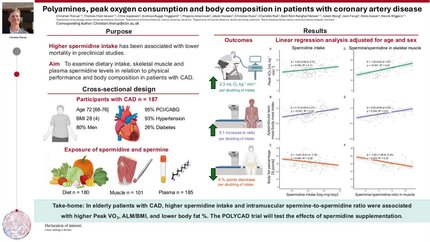
Higher dietary spermidine intake has been associated with lower cardiovascular mortality. Spermidine and spermine support cellular homeostasis and mitochondrial function across species, but their relevance to physical and mitochondrial function in humans remains unclear. We examined associations of dietary spermidine and circulating and skeletal muscle spermidine and spermine with physical performance, body composition, and mitochondrial respiratory capacity in older patients with coronary artery disease.
We included 187 patients with coronary artery disease [median age 72 (68–76) years; 80% men; 95% with prior coronary revascularization]. The primary outcomes were peak oxygen uptake and appendicular lean mass. Each doubling of dietary spermidine intake was associated with higher peak oxygen uptake (β 2.6 mL·kg−1·min−1, 95% CI 0.9–4.4;
These observational findings warrant randomized trials to determine whether dietary spermidine interventions may influence physical and mitochondrial function in older patients with coronary artery disease.
Contributors


Thomas Hvid Jensen
Author

Mogens Johannsen
Author
Jakob Hansen
Author
Christian Lodberg Hvas
Author
Charlotte Lock Rud
Author
Bent Roni Ranghøj Nielsen
Author
Jakob Wang
Author
Jean Farup
Author
Niels Jessen
Author
Henrik Wiggers
Author
Magnus Bäck
Author
You may be interested in