Explainable age prediction using a transformer trained on diverse global electrocardiograms
European Heart Journal - Digital Health


Abstract
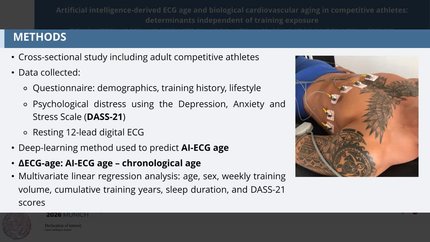
Artificial intelligence (AI) models trained on electrocardiograms (ECGs) can estimate age, with deviations from chronological age (Δage) serving as markers of accelerated cardiovascular ageing. We evaluated whether transformer-based AI models trained on globally diverse, heterogeneous ECG datasets outperform convolutional neural network (CNN)-based models in generalizability and physiological interpretability.
Using 11 public datasets (435 203 recordings) from four continents and an independent external cohort (14 462 recordings), we trained and validated transformer and CNN architectures. The transformer model trained on global data achieved strong correlation with chronological age and maintained robust performance in the external cohort (
Our findings establish that transformer models trained on globally heterogeneous data generalize well and can provide insights to plausible ageing signatures. Furthermore, Δage may offer insight into underlying physiological ageing processes and associated risk, though further validation is needed to define its clinical utility in risk stratification.
Contributors

Laurenz Berger
Author
Kristina Preuer
Author
Christoph Gross
Author
Max Haberbusch
Author
Mohammad Azizzadeh
Author

Marie-Kathrin Breyer
Author
Francesco Moscato
Author
You may be interested in