The impact of high microvascular resistance on coronary wave energetics depends on coronary microvascular functionality

EHJ - Open

5 May 2025
Organised by: Logo
ESC Journals CORONARY ARTERY DISEASE, ACUTE CORONARY SYNDROMES, ACUTE CARDIAC CARE BASIC SCIENCE

Abstract

AbstractAims

The pathophysiological relevance of high hyperemic microvascular resistance (hMR) in stable coronary artery disease is controversial. Using wave intensity analysis (WIA, defined as the product of the time derivatives of the coronary pressure and velocity), we aim to compare the impact of high hMR on coronary wave energetics with respect to coronary microvascular dysfunction (CMD), defined as reduced coronary flow reserve (CFR < 2.5), in unobstructed arteries.

Methods and results

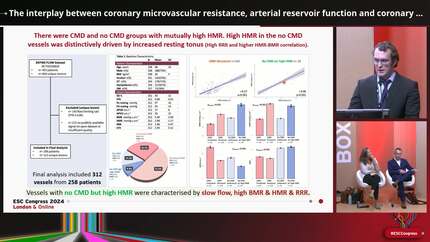
The study population (n = 258, mean age = 68 ± 10 years, 73% male) had a high cardiovascular risk profile including dyslipidemia (88%), hypertension (70%), smoking (55%) and diabetes (28%). The mean fractional flow reserve was 0.89 ± 0.05. Vessels (n = 312) were divided into four endotypes: no CMD-low hMR (CFR ≥ 2.5, hMR < 2.5 mmHg.s.cm−1), Functional CMD (CFR < 2.5, hMR < 2.5 mmHg.s.cm−1), Structural CMD (CFR < 2.5, hMR ≥ 2.5 mmHg.s.cm−1), and no CMD-high hMR (CFR ≥ 2.5, hMR ≥ 2.5 mmHg.s.cm−1). The no CMD-high hMR endotype had the lowest mean resting velocity (bAPV = 10 ± 3 cm.s−1  P < 0.001), highest mean basal microvascular resistance (bMR = 9 ± 2 mmHg/cm.s−1  P < 0.001) amongst all endotypes, yet, it had reference-level CFR, microvascular resistance reserve and resistive reserve ratio (P > 0.05 for all compared to no CMD-low hMR), unlike CMD endotypes (P < 0.05 compared to CMD endotypes). The no CMD–high hMR endotype exhibited the highest hyperemic increase in the accelerating wave energy proportion (AEP) (13% ± 13%, P = 0.042), indicating an intact autoregulatory response. Only in the CMD endotypes, high hMR was associated with reduced AEP (r = −0.229, P < 0.001), unlike no CMD endotypes (P = 0.383).

Conclusion

High hMR alone is not a definitive CMD marker. In line with the adaptive high hMR hypothesis, increased hMR does not necessarily limit augmentation of AEP, and is associated with robust autoregulatory capacity in vessels with preserved CFR. Cardiologists should be alert to a potential adaptive no CMD–high hMR endotype to avoid misdiagnosis.

Registration

NCT02328820.

Contributors

Ahmet Tas
Ahmet Tas

Author

Amsterdam University Medical Centre (AUMC) Amsterdam , Netherlands (The)

Murat Sezer
Murat Sezer

Author

Istanbul University (1453) Istanbul , Turkiye