Overall coronary disease burden modifies the prognostic benefit of CTO-PCI: a SYNTAX score–stratified meta-analysis
EHJ - Open


Abstract
Extensive coronary artery disease (CAD) coexisting with chronic total occlusion (CTO) is associated with adverse outcomes, yet patients with advanced CAD are often underrepresented in randomized trials, and the prognostic impact of CTO percutaneous coronary intervention (CTO-PCI) across different levels of anatomical complexity remains uncertain. We aimed to determine whether the overall CAD burden, quantified by the SYNTAX score (SS), influences the prognostic effect of CTO-PCI.
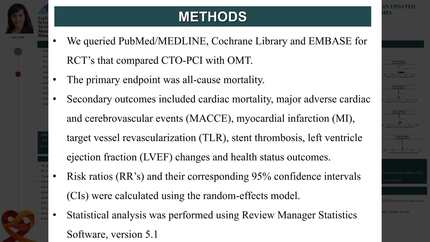
A systematic search of PubMed, Embase, Google Scholar, and Cochrane databases was conducted. Eligible studies compared successful CTO-PCI vs. no CTO-PCI and reported the mean SYNTAX score of the cohort. Two reviewers independently extracted data. The primary endpoint was annualized cardiovascular (CV) mortality. Pooled hazard ratios (HRs) were calculated using fixed- or random-effects models with inverse-variance weighting. Meta-regression explored the relationship between SS and CV mortality, and subgroup analyses were performed according to predefined SS categories. Seventeen studies (3 randomized and 14 prospective observational; n = 11 001) were included. Successful CTO-PCI was associated with significantly lower CV mortality compared with non-revascularization (HR 0.54; 95% CI 0.46–0.64;
The survival benefit of CTO-PCI appears to increase with the extent of overall coronary disease, suggesting that patients with higher anatomical burden may derive greater prognostic benefit from successful CTO revascularization.
Contributors

Kambis Mashayekhi
Author
Agostino Spanò
Author
Michael Behnes
Author
Pierfrancesco Agostoni
Author
Daniel Weilenmann
Author
Giuseppe Colletti
Author
Maourane Boukhris
Author
Giulio Cocco
Author
Cammalleri Valeria
Author
Annunziata Nusca
Author
Gian Paolo Ussia
Author
You may be interested in