Genotype status and arrhythmic risk in sport participants with hypertrophic cardiomyopathy
EHJ - Open


Abstract
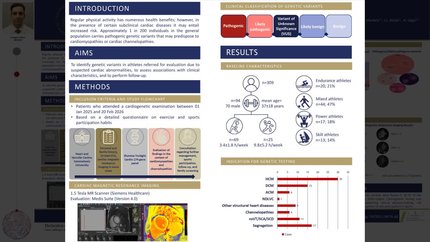
The impact of genotype on arrhythmic risk in sports-active hypertrophic cardiomyopathy (HCM) patients remains unclear. We compared outcomes between genotype-positive (G+) and genotype-negative (G−) athletes with HCM.
In this retrospective study, HCM patients actively engaged in sports underwent standardized baseline evaluation and follow-up. The primary endpoint included sudden cardiac death (SCD)/sudden cardiac arrest, appropriate implantable cardioverter-defibrillator (ICD) therapy, sustained ventricular tachycardia/non-sustained ventricular tachycardia (NSVT). Secondary outcomes included a composite of ventricular arrhythmias, atrial fibrillation, ischaemic stroke, and heart-failure hospitalization. Fifty-nine patients [age 40 years (23.2–50.0)] were followed for 6.3 years (3.0–12.6). Twenty-nine participants (49.2%) carried a likely pathogenic or pathogenic variant, most commonly MYBPC3 (44.8%), MYH7 (24.1%), and TNNT2 (17.2%). At inclusion, median sport practice was 6.0 (3.0–10.0) hours per week, with 67.8% of competitors. At last follow-up, 88.1% remained active in sports. The ESC 5-year SCD risk score was slightly higher in G+ compared with G− patients [1.87% (1.47–3.67) vs. 1.54% (1.24–2.20),
In this exploratory cohort of sports-active HCM patients, ventricular arrhythmic and cardiovascular event rates were similar between G+ and G− participants during follow-up.
Contributors

Frédéric Myon
Author
Mathilde Delatour
Author
Nathalie Behar
Author
François Carré
Author
Erwan Donal
Author

Magnus Back
Author
You may be interested in