Bioprosthetic vs. mechanical prostheses in patients aged 50–70 years undergoing aortic valve replacement surgery: outcomes analysis from propensity score matching
EHJ - Open


Abstract
Bioprosthetic valves are increasingly used for surgical aortic valve replacement (SAVR) in patients ≤ 70 years though the relative benefits compared to mechanical valve replacement remain uncertain. This study aims to compare mortality and other outcomes by prosthesis type for patients aged 50–70 years who received SAVR in a well-characterized Australian cohort.
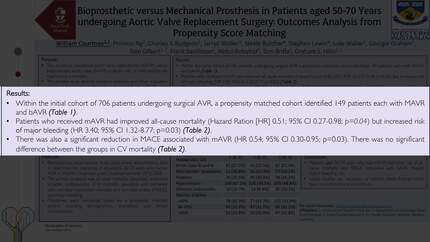
Data were prospectively collected at the time of heart valve surgery and linked administrative outcome data. This analysis includes all patients aged 50–70 years who had SAVR in Western Australian public hospitals between 2010 and 2020. The primary endpoint was all-cause mortality. Secondary endpoints were cardiovascular mortality, separately and combined with admission for either non-fatal myocardial infarction or for non-fatal stroke (MACE), major bleeding, and days alive and out of hospital (DAOH). Outcomes, categorized by prosthesis type (mechanical or bioprosthetic), were compared using propensity matching. Within the initial cohort of 706 patients undergoing SAVR (mean age 62.5 years, SD 6), propensity score matching identified 149 patients each with mechanical or bioprosthetic valves. After adjustment, patients who received mechanical valves had lower all-cause mortality [adjusted hazard ratio (aHR) 0.51; 95% confidence interval (CI) 0.27–0.98;
Patients aged 50–70 years who underwent mechanical valve SAVR had lower risk of all-cause mortality and MACE compared with those who received a bioprosthesis, despite higher bleeding risk. Randomized comparisons are necessary to confirm these findings.
Contributors

Primero Ng
Author
Charley Budgeon
Author
Jarryd Walker
Author
Steele Butcher
Author
Stephen Lewin
Author
Luke J Waller
Author
Georgie Graham
Author
Tom Gilbert
Author
James Edelman
Author
Pragnesh Joshi
Author
Christopher M Reid
Author
Frank M Sanfilippo
Author
Abdul Ihdayhid
Author
Tom Briffa
Author
Patrizio Lancellotti
Author
You may be interested in