Association of physiological discordance between fractional flow reserve and non-hyperaemic pressure ratios with lipid-rich plaque burden
EHJ - Open


Abstract
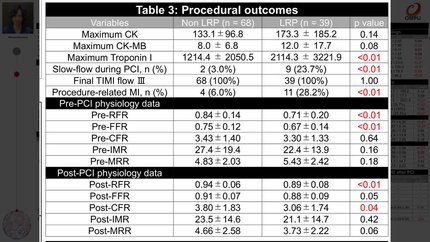
Fractional flow reserve (FFR) and non-hyperaemic pressure ratios (NHPRs) frequently yield discordant results in clinical practice, yet the mechanisms underlying this mismatch remain uncertain. Plaque composition has been suggested to influence FFR, raising the possibility that discordance reflects the features of lipid-rich plaque (LRP). This study aimed to investigate whether physiological discordance between FFR and NHPR is associated with increased lipid burden.
We retrospectively analysed 217 intermediate coronary lesions from 189 patients who underwent FFR, NHPR, and near-infrared spectroscopy with intravascular ultrasound imaging. Lesions were classified using established cut-offs for FFR (0.80) and NHPR (0.89). Lipid burden was quantified by the maximum lipid core burden index within any 4-mm segment (maxLCBI4mm). Lipid-rich plaque was defined as maxLCBI4mm > 400. The clinical endpoint was 3-year target vessel failure (TVF). Physiological discordance occurred in 24.0% of lesions, predominantly as an FFR+/NHPR− pattern (19.8%). FFR was independently associated with maxLCBI4mm [
FFR+/NHPR− lesions exhibit markedly greater lipid burden, suggesting that hyperaemia-based indices better capture plaque vulnerability than resting physiology. This pattern may serve as a marker of plaque vulnerability, suggesting that deferral of FFR+/NHPR− lesions could warrant caution given their higher lipid burden.
Contributors

Hirohiko Aikawa
Author

Yu Kataoka
Author
Yuriko Nakaoku
Author
Soshiro Ogata
Author
Takamasa Iwai
Author
Kenichiro Sawada
Author
Hideo Matama
Author
Hiroyuki Miura
Author
Satoshi Honda
Author
Masashi Fujino
Author
Shuichi Yoneda
Author
Kazuhiro Nakao
Author
Kensuke Takagi
Author
Kunihiro Nishimura
Author
Teruo Noguchi
Author
Salvatore De Rosa
Author
You may be interested in