Biopsychosocial phenogroups in an urban population with coronary artery disease and their associations with adverse cardiovascular events
EHJ - Open


Abstract
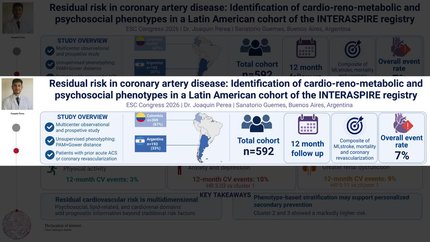
Patients with stable coronary artery disease (CAD) are clinically heterogeneous and exhibit differential treatment responses. We aimed to identify distinct CAD phenogroups based on psychosocial, autonomic, and cardiovascular characteristics and to examine their risk of adverse cardiovascular events.
We pooled data from 949 participants with stable CAD enrolled in two related studies. Phenogroups were derived using Gaussian mixture model clustering applied to 12 pre-specified markers readily obtainable in ambulatory clinical settings: autonomic dysfunction, psychosocial stress, myocardial injury, obstructive CAD burden, left ventricular ejection fraction, and blood pressure. Hazard ratios (HRs) were estimated to examine the associations between the derived phenogroups and composite major adverse cardiovascular events (MACE), cardiovascular disease (CVD)-specific, and all-cause mortality. The mean age was 60 ± 10 years; 34% were women and 41% were Black. Four phenogroups were identified: phenogroup 1 (
Psychosocial and autonomic factors, when combined with cardiovascular risk characteristics, result in clinically meaningful CAD phenogroups with varying risk of adverse cardiovascular events that may help guide personalized interventions.
Patients with stable coronary artery disease exhibit distinct clusters of psychosocial, autonomic, and cardiovascular characteristics that influence their risk of adverse cardiovascular events Among this high-risk population, the most prevalent group was characterized by elevated psychosocial stress and frequent angina and was associated with a higher risk of adverse cardiovascular events. More research is needed to test whether integrating psychosocial stress assessment and targeted behavioral or psychosocial interventions into secondary prevention strategies, alongside standard medical therapy, may help reduce the risk of adverse cardiovascular events in these high-risk patients.
Contributors

Jeffery Osei
Author
Louis Y Li
Author
Kara Suvada
Author
Luis C Correia
Author
J Douglas Bremner
Author
Yi-An Ko
Author
Arshed A Quyyumi
Author
Yan V Sun
Author
Viola Vaccarino
Author
Amit J Shah
Author
Magnus Bäck
Author
You may be interested in