Plasma ceramide and phospholipid-based risk score and the risk of cardiovascular death in patients after acute coronary syndrome
European Journal of Preventive Cardiology


Abstract
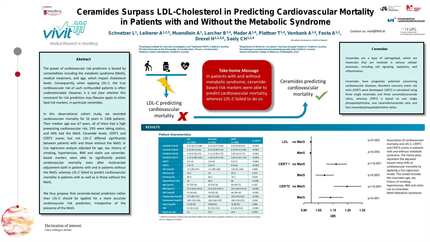
Ceramide (Cer) and phosphatidylcholine (PC) lipids are associated with pathophysiological processes in cardiovascular (CV) diseases. A previously derived and validated plasma Cer-PC risk score (CERT2) was associated with CV death risk in patients with stable disease, but its prognostic value has not been evaluated in patients early post-acute coronary syndrome (ACS).
Prespecified plasma Cer and PC species in the CERT2 risk score were measured in 4871 subjects from SOLID-TIMI 52, which enrolled patients ≤30 days after ACS (median follow-up 2.5 years). The CERT2 score (scale 0–12 points) was calculated as previously defined. The primary outcome was CV death; Coronary heart disease death, all-cause death, hospitalization for heart failure (HF), myocardial infarction (MI) and stroke were also analyzed. Poisson models included baseline characteristics and established biomarkers. Patients with higher CERT2 risk scores were more likely to be older, female, current smokers, presenting with STEMI, and to have impaired renal function and higher LDL-C. After multivariable adjustment, patients in the highest risk score category remained at a nearly two-fold higher risk of CV death (adj relative risk [RR] 1.92, 95% CI 1.01–3.66,
A plasma ceramide and phospholipid-based risk score is associated with the risk of CV death independent of established clinical risk factors and biomarkers in patients after ACS.
Contributors

Eugene Braunwald
Author
Brigham and Women's Hospital, Harvard Medical School Boston , United States of America

Erica L Goodrich
Author
Mika Hilvo
Author
Dimple Kauhanen
Author
Marc S Sabatine
Author
Reijo Laaksonen
Author
Baris Gencer
Author
David A Morrow
Author
Michelle L O’Donoghue
Author
You may be interested in