Effect of anti-fibrotic therapy on regression of myocardial fibrosis after TAVI: design and rationale of the Reduce-MFA DZHK25 trial
ESC Heart Failure


Abstract
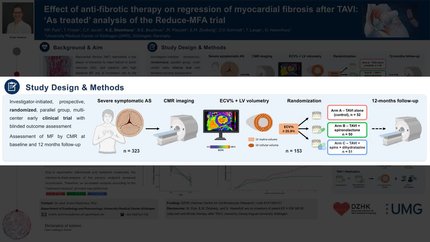
Myocardial fibrosis (MF) represents a key player in transition to heart failure in aortic stenosis (AS), and AS patients with high baseline MF are at increased risk to die within 12 months after transcatheter aortic valve implantation (TAVI). Therefore, the objective of the Reduce-MFA DZHK25 trial is to assess the impact of anti-fibrotic therapy on regression of AS-induced MF after TAVI in patients with high baseline fibrotic burden. Key secondary objectives include reverse LV remodelling, symptomatic improvement, and reduction of mortality and cardiac hospitalizations.
Reduce-MFA represents a national, prospective, randomized, parallel group, controlled, open-label interventional multi-centre trial with blinded outcome assessment (PROBE design) enrolling patients with severe AS scheduled for TAVI. The anti-fibrotic principles employed are spironolactone and low-dose dihydralazine (epigenetic reactivation of anti-fibrotic genes). Baseline burden and course of MF are assessed by cardiac MRI (CMR). Since CMR-derived extracellular volume fraction (ECV%) ≥ 25.9% emerged as independent mortality predictor, only patients above this cut-off are randomized into three parallel groups: (i) Standard of Care alone, (ii) + spironolactone, (iii) + spironolactone + low-dose dihydralazine, each for 12 months. To assess MF regression, CMR is repeated after 12 months. MF is assessed by quantification of the ECV-derived LV matrix volume using T1 mapping. Additionally, measures of heart failure (Kansas City Cardiomyopathies Quality of Life Questionnaire, 6MWT, NT-proBNP, NYHA class) and reverse cardiac remodelling are evaluated at 6 and 12 months. Mortality and cardiac hospitalizations are recorded. The recruitment was recently completed with 384 enrolled and 153 randomized patients.
The study findings have the potential to inform the development of a novel adjuvant therapy to improve the prognosis of specific AS patients.
Contributors

Elisabeth M Zeisberg
Author
Marius Placzek
Author
Bo E Beuthner
Author
Christoph F Jacob
Author
Kristin E Steinhaus
Author

Ralf Tostmann
Author
Moritz Schnelle
Author
Andreas Schuster
Author
Gerd Hasenfuß
Author

You may be interested in