Left ventricular transmural pressure and ventilatory inefficiency during exercise in advanced heart failure
ESC Heart Failure


Abstract
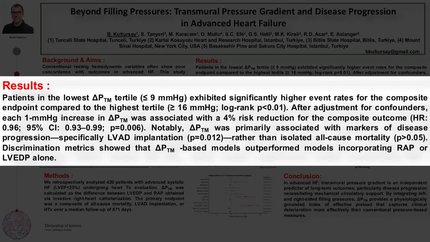
Baseline intracavitary haemodynamic measurements frequently demonstrate an inconsistent relationship with exertional performance. This may reflect an incomplete interpretation of left ventricular (LV) filling pressures. LV transmural pressure difference (ΔPTM = LV end-diastolic pressure [LVEDP]—right atrial pressure [RAP]) integrates LV filling pressure with right ventricular/pericardial constraint and may provide a composite representation of resting haemodynamic conditions. Ventilatory efficiency, assessed by the minute ventilation-carbon dioxide production (VE/VCO2) slope during cardiopulmonary exercise testing (CPET), is a leading representation of cardiopulmonary reserves and a powerful prognostic marker in heart failure (HF). Whether ΔPTM is associated with exercise ventilatory efficiency beyond conventional resting filling pressure measurements remains unclear.
We retrospectively studied 422 patients with advanced HF (LVEF ≤25%) who underwent right-heart catheterization and CPET. ΔPTM was analysed both continuously and by tertiles. The primary outcome was VE/VCO2 slope; peak VO2 was a secondary outcome. Bayesian multivariable regression models were adjusted using a directed acyclic graph-derived confounder set. Sensitivity analyses compared ΔPTM with LVEDP and RAP modelled individually and jointly.
Among 422 patients (mean age 51.3 ± 10.8 years; 62 [14.7%] female), higher ΔPTM was independently associated with a lower VE/VCO2 slope (posterior mean β = −0.34 per mmHg; 95% credible interval [CrI] −0.58 to −0.11; 99.7% posterior probability of a negative association). Unadjusted VE/VCO2 slope decreased from 40.2 (31.7–67.1) in the lowest ΔPTM tertile to 34.9 (30.6–44.8) in the highest tertile (
Resting ΔPTM was inversely associated with the VE/VCO2 slope during exercise, whereas no independent association was observed with peak VO2. Compared with individual left- or right-sided filling pressures, ΔPTM provides a parsimonious summary of the balance between left-sided distending pressure and right-sided constraint associated with ventilatory efficiency in advanced HF.
Contributors


Seda Tanyeri Uzel
Author
Murat Karacam
Author
Seref Berk Tuncer
Author
Azmican Kaya
Author
Halit Eminoglu
Author
Suleyman Cagan Efe
Author
Gulumser Sevgin Halil
Author
Cem Dogan
Author

Mehmet Kaan Kirali
Author
Rezzan Deniz Acar
Author
Emre Aslanger
Author
You may be interested in