Distinct prognostic trajectories of heart failure phenotypes following kidney transplantation
ESC Heart Failure


Abstract
Heart failure (HF) drives post-kidney transplant (KT) morbidity. While KT reverses components of uraemic cardiomyopathy, the persistence of post-transplant risk in HF with preserved (HFpEF) versus HF with reduced ejection fraction (HFrEF) remains unclear. We evaluated phenotype-specific remodelling and clinical outcomes.
Retrospective cohort of adult KT recipients stratified by pre-transplant echocardiography: HFpEF (left ventricular ejection fraction [LVEF] ≥50% with elevated filling pressures), HFrEF (LVEF <50%), or controls. Longitudinal echocardiographic remodelling and post-transplant outcomes were analysed using multivariable Cox regression.
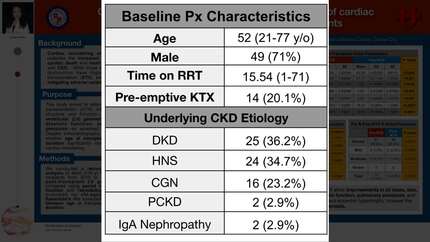
Of 442 recipients, 64 (14.5%) had HFpEF, 44 (10.0%) HFrEF, and 334 (75.5%) controls. Over a 49-month median follow-up, HFpEF was independently associated with HF hospitalization (adjusted hazard ratio [aHR] 9.57; 95% confidence interval [CI] 3.37–27.2,
Post-KT trajectories differ by pre-transplant HF phenotype. Uraemic HFpEF is a persistent, non-reversible phenotype driving severe post-KT morbidity. HFrEF demonstrates systolic reversibility. Pre-transplant evaluation should incorporate targeted diastolic profiling beyond standard LVEF-centred assessment to identify KT candidates at high risk for recurrent post-transplant HF morbidity.
Contributors

Maor Bril
Author
Ashraf Imam
Author
Elchanan Parnasa
Author
Michael Rivin
Author
Suha Shabaneh
Author
Keren Tzukert
Author
Abel Roai
Author
Offer Amir
Author
Abed Khalaileh
Author

You may be interested in