Baseline right ventricular assessment and outcomes after transcatheter tricuspid valve repair
European Heart Journal - Valvular and Structural Heart Disease


Abstract
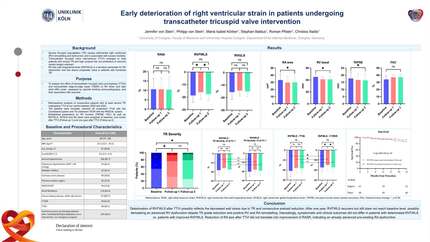
Tricuspid regurgitation (TR) and right ventricular (RV) remodelling are closely related. Recent European Society of Cardiology/European Association for Cardio-Thoracic Surgery guidelines on valvular heart disease propose adjusted reference values for RV size and function.
To determine the predictive value of the proposed RV dilatation and dysfunction thresholds in a real-world interventional cohort.
Echocardiographic thresholds were evaluated retrospectively in 651 patients, who underwent transcatheter tricuspid valve repair (TTVr) at two tertiary centres.
The primary endpoint was 2-year survival [Kaplan–Meier estimate: 78.6% (74.9–81.9)]. RV strain was the most frequent marker of dysfunction at baseline [free walls strain (FWS) <23% in 80.3%, global longitudinal strain (GLS) <21% in 88.4%]. Proposed cut-offs for RV basal (>24 mm/m2), mid (>21 mm/m2), and tricuspid annular (TA) diameters (>21 mm/m2) were associated with survival (
TTVr is often performed at an advanced disease stage, and adverse RV remodelling is strongly associated with survival. Nevertheless, effective TR reduction attenuated this prognostic value.
Contributors

Jan Althoff
Author


Mariama Touray
Author
Caroline Hasse
Author
Thorsten Gietzen
Author
Jonathan Curio
Author
Johannes Kirchner
Author
Muhammed Gerçek
Author


Stephan Baldus
Author

Maria I Körber
Author
You may be interested in