Prognostic impact of domiciliary care prior to transcatheter aortic valve implantation: a nationwide study
European Heart Journal - Valvular and Structural Heart Disease


Abstract
Domiciliary care can serve as a marker of frailty and vulnerability, which may influence outcomes following transcatheter aortic valve implantation (TAVI). The relationship between receipt of domiciliary care prior to TAVI and clinical outcomes has not been systematically evaluated and may influence patient selection and pre-procedural counselling.
The study population included all adult patients with a diagnosis of aortic stenosis undergoing first-time TAVI from 1 January 2015, to 31 December 2023. Patients were categorized into those with and without domiciliary care within 1 year prior to TAVI. Patients were followed for 1 year after TAVI. All-cause mortality was assessed using Kaplan-Meier estimates and multivariable Cox proportional hazards models. Cumulative days of hospitalization within 1 year after TAVI were calculated and categorized as 0–14 days and >14 days. The association between domiciliary care and >14 cumulative days of hospitalization was evaluated using multivariable logistic regression.
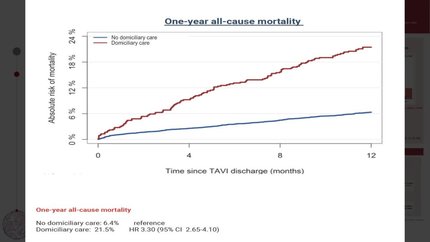
We identified 7607 patients undergoing TAVI, 541 (7.1%) with domiciliary care (76.7% living alone; 39.4% men; median age 83 years) and 7066 (92.9%) without domiciliary care (40.5% living alone; 59.4% men; median age 81 years). Overall, patients with domiciliary care carried a higher comorbidity burden and were more frequently classified in higher frailty groups. From discharge, the absolute 1-year risk of death was 21.5% in patients with domiciliary care and 6.4% in patients without. In adjusted analysis, patients with domiciliary care had an increased associated 1-year mortality [hazard ratio 3.30; 95% confidence interval (CI) 2.65–4.10,
Patients receiving domiciliary care before undergoing TAVI had a higher mortality and cumulative days of hospitalization within 1 year following the procedure, highlighting a high-risk group of patients. More research is needed to improve risk stratification of TAVI patients.
Contributors

Jeppe K Petersen
Author
Martha Meibom
Author

Louise Marqvard Sørensen
Author
Rigshospitalet - Copenhagen University Hospital Copenhagen , Denmark
Morten Schou
Author
Jonas Agerlund Povlsen
Author
Christian Juhl Terkelsen
Author
Ashkan Eftekhari
Author
Henrik Nissen
Author
Ole de Backer
Author

Emil Fosbøl
Author
You may be interested in