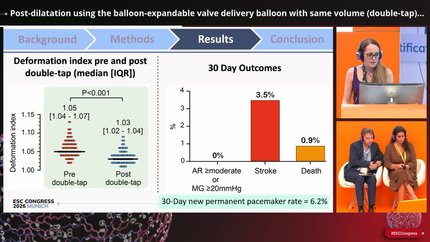
Post-dilatation using the balloon-expandable valve delivery balloon with same volume (double-tap) to optimize transcatheter aortic valve expansion
European Heart Journal - Valvular and Structural Heart Disease


Abstract
Transcatheter heart valve (THV) underexpansion is associated with haemodynamic valve deterioration. Double inflation of balloon-expandable valves using the delivery balloon with unchanged volume (double-tap) may improve THV expansion, while minimizing the risk of complications.
To evaluate the efficacy of double-tap after transcatheter aortic valve implantation (TAVI) with SAPIEN-3 Ultra RESILIA (S3UR) valves.
This observational study included consecutive patients who underwent TAVI for severe native aortic stenosis and had same-volume double-tap, from November 2024 to September 2025. THV expansion and deformation were assessed fluoroscopically before and after double-tap after appropriate calibration. Thirty-day clinical outcomes were reported.
Of 113 patients who underwent TAVI with same-volume double-tap (mean age: 79.3 ± 7.3 years, 26.5% female, 13.3% bicuspid anatomy), the median THV expansion before double-tap, at the inflow, mid-portion, and outflow was 88.6% (IQR: 86.4–90.4%), 80.1% (IQR: 77.3–82.3%), and 90.1% (IQR: 88.4–90.9%) respectively, and after double-tap increased to 96.4% (IQR: 94.6–98.4%), 90.8% (IQR: 88.6–92.9%), and 97.6% (IQR: 96.3–99.0%) (all
Routine double-tap post-dilatation of balloon-expandable valves improves THV expansion and frame deformation, without any clear safety signal. Bicuspid anatomy and aortic valve calcium burden predicted the extent of expansion improvement.
Contributors


Samuel Norman
Author
Noman Ali
Author
Michael S Cunnington
Author
Christopher J Malkin
Author
Ole De Backer
Author
Daniel J Blackman
Author
You may be interested in